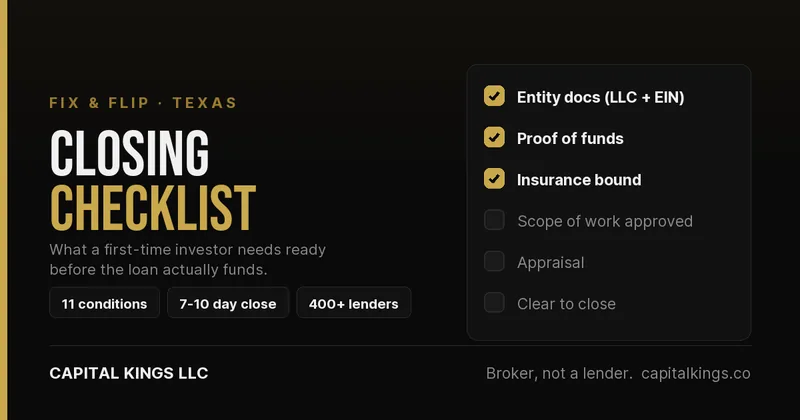
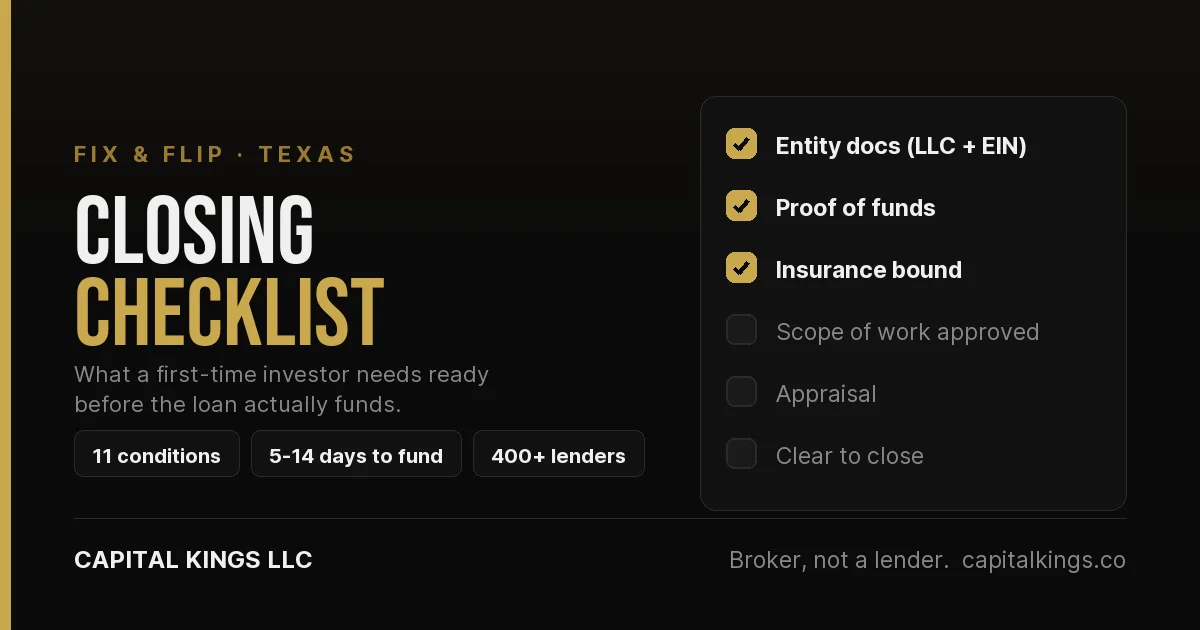
- A fix and flip file has 11 conditions. Eight have to clear before the lender funds, and only four of those are on you: the rehab budget, your entity docs, proof of funds, and the credit check. The rest sit with the lender, title, and insurance, and they all get worked at the same time once you've handed off your part.
- Four things stall first-time investors the most: entity docs (the LLC filing plus the EIN letter and operating agreement), full bank statement PDFs, a line item rehab budget instead of a lump sum, and proof of funds that covers cash to close plus a reserve. You can get all four done before you're under contract.
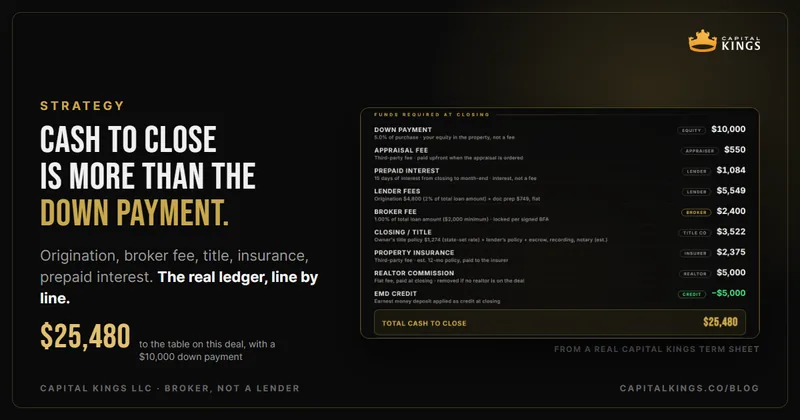
- Cash to close is the down payment plus origination, the broker fee, lender fees, Texas title, prepaid interest, insurance, and the appraisal, minus any earnest money you've already paid. Stronger credit doesn't always mean less cash at the table, and I walk through the real numbers on why.
You got the term sheet and the numbers work. You signed it, sent it back, and then everything went quiet, and now you're wondering what you're supposed to be doing.
Nobody really explains that gap. Between a signed term sheet and money wired to the title company, your file picks up a list of conditions. A condition is just a box somebody has to check before the lender will release money, and each one has a name and a person responsible for it. A fix and flip file has eleven. Eight have to clear before anyone funds anything, and only four of those have your name on them: the rehab budget, your entity docs, proof of funds, and the credit check. The rest belong to the lender, the title company, and an insurance agent, and they all get worked at the same time once you've handed off your part.
That ratio is the most useful thing to understand about closing. Most of the waiting isn't on you, and the part that is can be done before you're even under contract. This is the checklist I walk first-time investors through. I'm a broker, so it's built around what several different lenders each want at closing. The process works the same way anywhere, but the filing fees, title timelines, and insurance rules below are the Texas versions.
What Happens Between Terms and Funding
A signed term sheet isn't an approval. It's the lender saying "these are the terms we'd lend on, assuming everything checks out." Underwriting is the checking out part, and it usually goes like this.
You sign the term sheet and the file opens
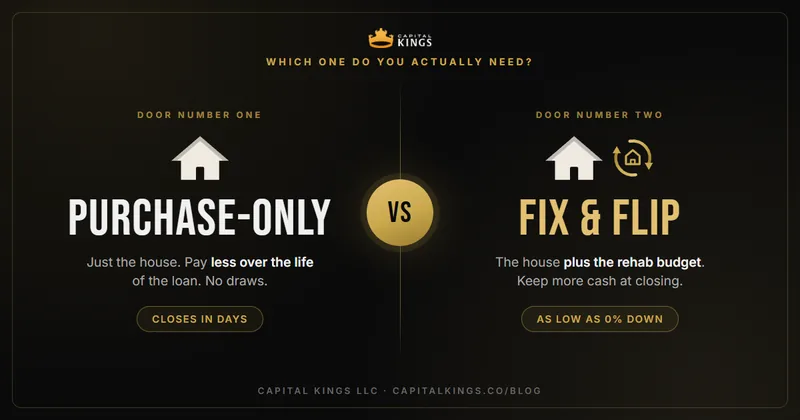
Your condition list depends on your loan type. A fix and flip file gets eleven line items. A purchase-only file gets nine, because with no rehab there's no scope of work to approve, no draw schedule, and usually no inspection.
You upload your documents
Contract, entity docs, bank statements, ID, rehab budget. Nothing you do has a bigger effect on your closing date, because underwriting can't clear your part of the file until these are in.
Third parties get ordered in parallel
The appraisal gets ordered, title gets opened, and your insurance agent gets asked for a hazard and builder's risk quote. None of these depend on each other, so they all run at once.
Underwriting clears conditions one at a time
Each condition moves from Not Started to In Progress to Approved. If something comes back short, you'll get asked for the one specific thing that's missing instead of a vague "we need more info."
Clear to close, then funding
Once the last condition clears, the lender issues final approval, closing documents go to title, and the wire follows. Five to fourteen days from a complete file is normal.
The clock doesn't start when you sign the term sheet. It starts when your last document lands. I've seen the same lender fund in six days and in five weeks, and the difference almost always came down to when the borrower's paperwork came in.
Your Closing Readiness Check
Tap each item you already have in hand. If you're not under contract yet, this list gives you a head start. If you are, it's your to-do list for today.
- LLC formed, with the EIN letter and operating agreementForming the LLC is the easy part. What people forget are the EIN letter from the IRS and the operating agreement, and an entity missing either one will hold up the file.
- Fully executed purchase contract, every page and amendmentThat includes addenda and any extension. Underwriting reads all of it.
- Two months of bank statements for every account you'll useDownload the full statement PDF from your bank instead of screenshotting the app. Send every page, even the blank ones.
- Government ID for every member listed on the entityNot just yours. If your partner is on the LLC, underwriting needs their ID too.
- A line item rehab budget, not a lump sumBreak it out room by room or trade by trade, with dollar amounts. A single number labeled rehab gets sent back.
- Proof of funds covering cash to close plus a reserveLenders want to see that you won't be down to your last dollar at closing with a whole rehab still ahead of you.
- An insurance agent lined up for hazard and builder's riskStart the quote early. This is the one people most often leave until the week of closing, and then it pushes the closing back.
- Title company chosen and a target closing date setIf the seller picked title, get the file number so we can start talking to them early.
- Contractor bid, or your own scope if you're doing the work yourselfDoing it yourself is fine. The budget still has to be itemized.
Everything on that list fits into six upload categories in the Capital Kings borrower portal: property contract, rehab budget, bank statements, government ID, LLC documents, and other. You get free access as soon as you start an application. It's where your term sheet, your conditions, and your documents all live, so you're never digging through an email thread trying to piece your loan back together.
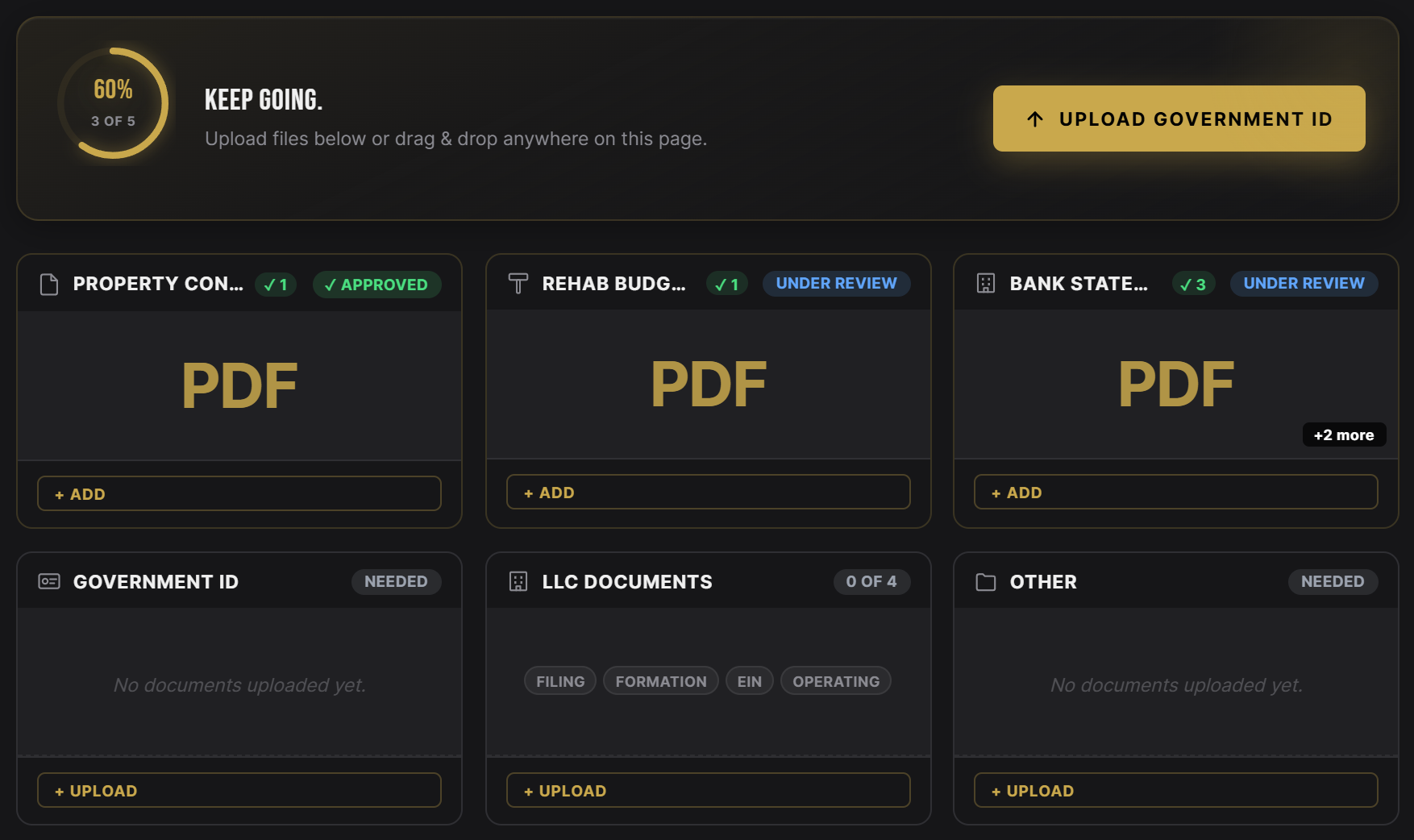
The one I want to call out is rehab budget, because that's where the most files get sent back. A lender isn't being difficult when they reject a lump sum. They're funding that rehab in draws, and a draw inspector has to be able to walk the property and say "the kitchen line was $14,000, the kitchen is done, release it." Nobody can inspect against a number that just says $65,000. I explain how that money gets released to you in how construction draws and rehab holdbacks work.
How Long Each Piece Takes
"Start early" isn't much help without real numbers. What you actually need to know is whether you can hit the closing date already written into your contract. These are Texas timelines in business days, and they overlap.
Most first-timers don't know this, but lenders close on an insurance binder (proof the coverage is in place). You don't have to wait for the fully issued policy. If someone tells you closing is waiting on the policy, ask why.
The Eleven Conditions, And Who Owns Each One
This is the part that should take some of the stress out of waiting. When a deal feels stalled, it's almost always sitting with one specific person, and a lot of the time that person isn't you. Filter the list by who's holding each item.
You won't be guessing at any of this while it's happening. This is what a fix and flip file looks like partway through, trimmed to the eight items that applied to that property.
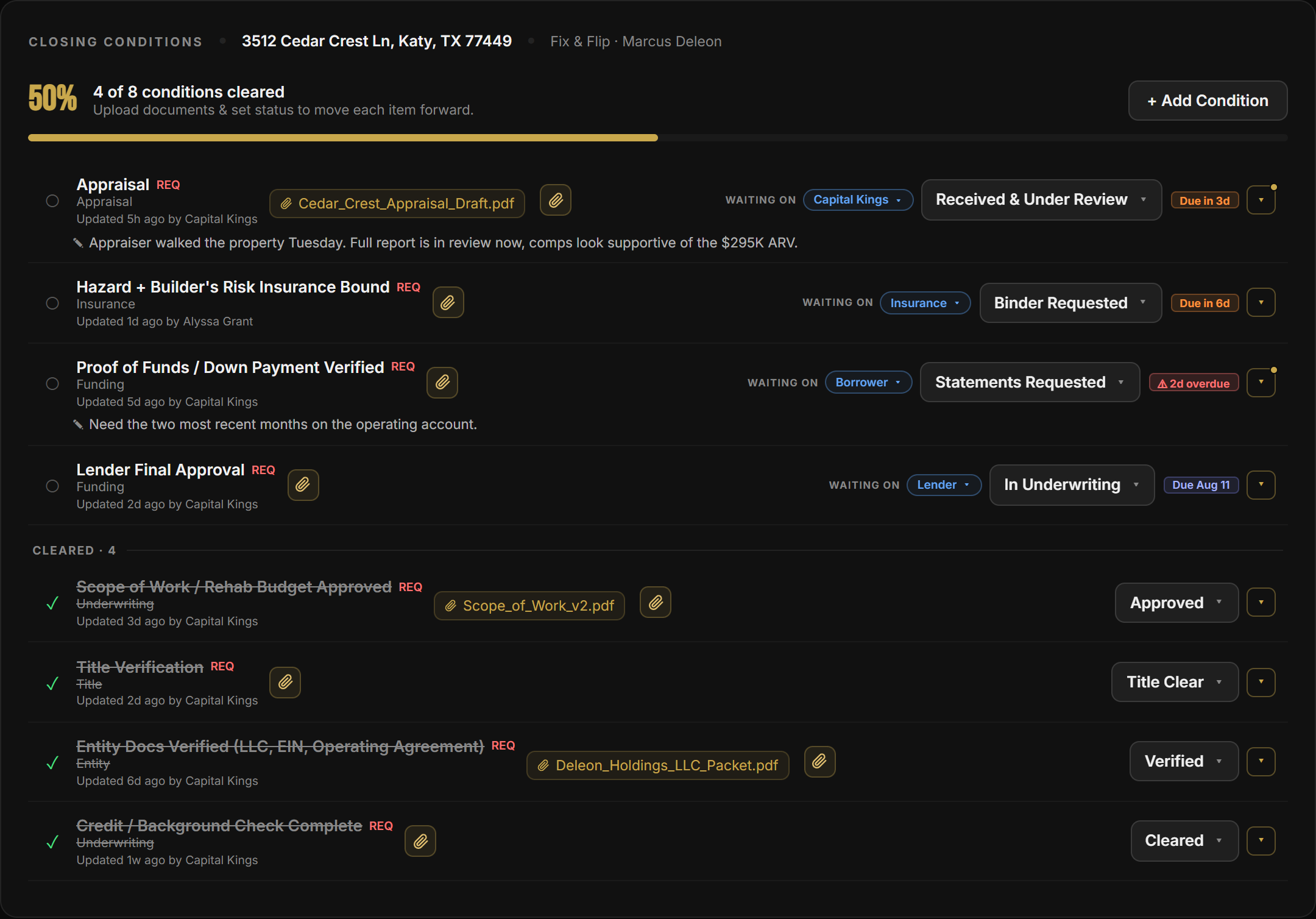
That's the difference between a checklist and a tracker. Instead of a vague "we're still working on it," you can see that the insurance binder was requested, that the appraiser walked the property Tuesday and the report is in review, and that the only thing anyone needs from you is two months of statements on the operating account.
Cash To Close Is Not Just Your Down Payment
This is the number that catches people off guard. You budget for a 10% down payment, the settlement statement comes back several thousand dollars higher, and it feels like something went wrong. It didn't. Cash to close is the down payment plus the costs of putting the loan together.
The one people miss is lender fees. They aren't a percentage of anything, so they never make it into the mental math. They're flat charges for underwriting, processing, and document preparation. Our term sheets use $749 all in as the default, and a more expensive lender can charge a couple thousand. Either way, they show up on the settlement statement, and they're part of the gap between the down payment you budgeted for and the number title asks you to wire.
Every one of those line items is on your term sheet before you ever get to the closing table, so the loan costs in your signing folder should match what you already read. Title will add its own escrow and tax proration lines. Those come from the seller's side and the county, so you'll see them for the first time on the settlement statement.
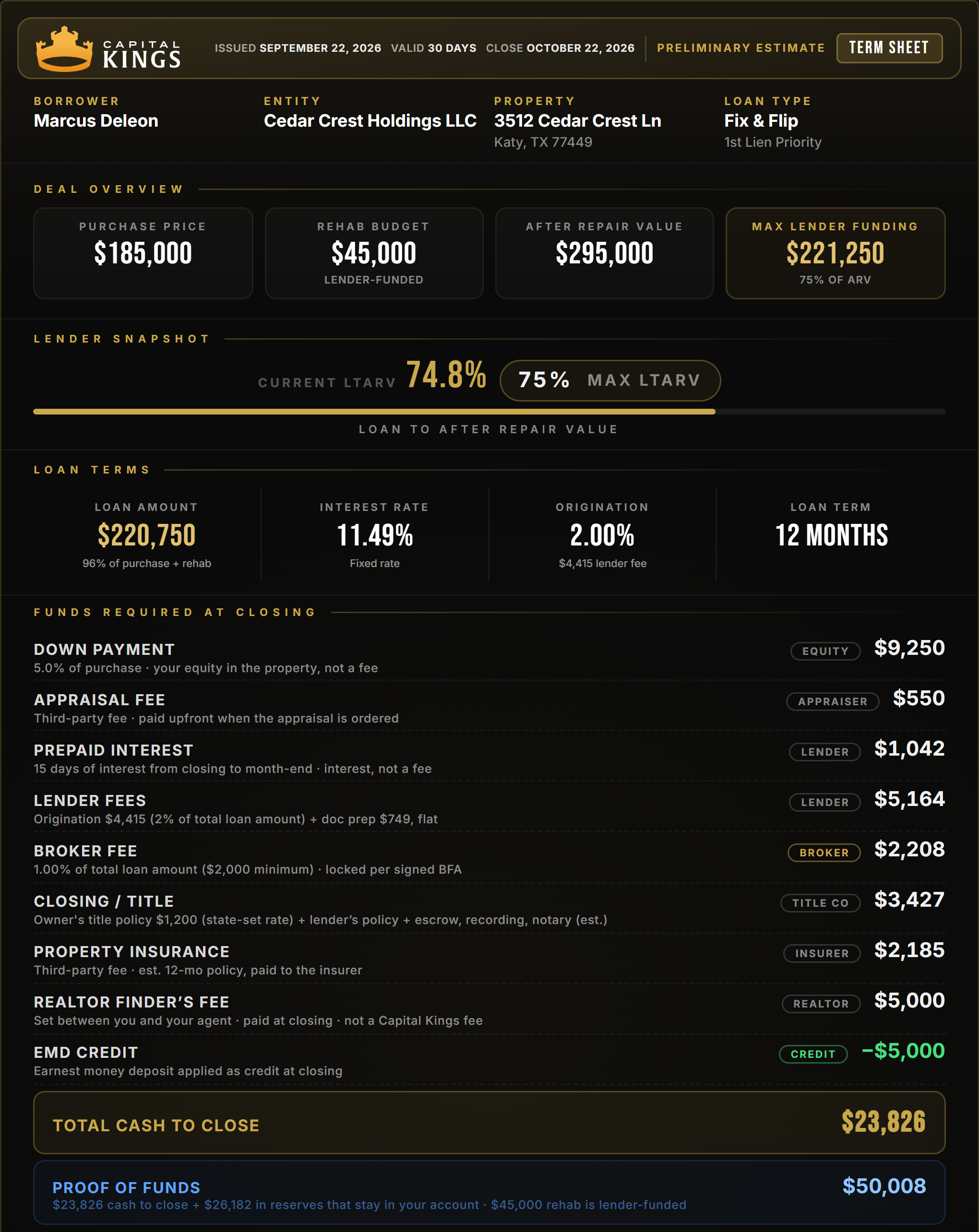
Run your own numbers below. This uses the same pricing engine that builds our term sheets, so it's a lot closer to a real answer than a generic mortgage calculator. It's still an estimate, though. The final figure changes with the appraised value and with which lender your file ends up with.
The rehab is held back and paid out in draws, so it usually isn't in your cash to close. The exception is a tight ARV. If the "sized by" line under the loan amount says 75% LTARV (loan to after repair value) instead of a down payment percentage, the cap is setting your loan, and whatever rehab it can't cover moves into your cash to close. I go through it line by line in cash to close on a fix and flip.
Why stronger credit can mean more cash at closing
This one surprises people: stronger credit doesn't always mean less cash at the table. Move the credit selector and you'll see the cash needed jump around instead of dropping steadily. That's not a penalty, and the calculator isn't broken. Your down payment isn't a grade on your credit. It comes down to which lender will take the file and how that lender structures it.
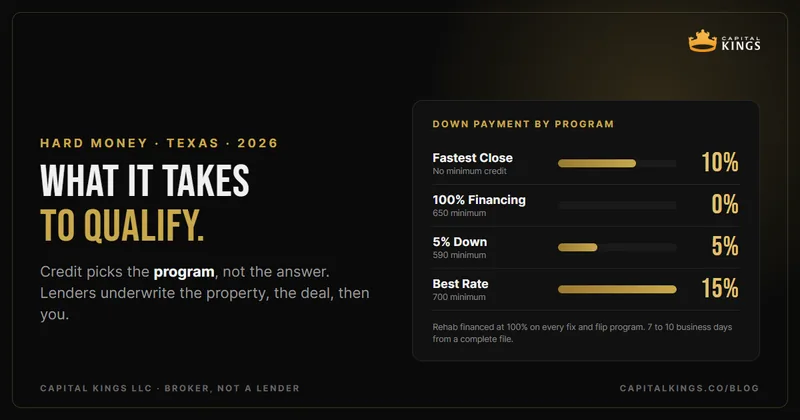
On Texas pricing, below 590, one lender will take bruised credit and close fast, and they want 10% down. At 590, a second lender opens up that'll do 5% down, the least cash of any option we have. At 700 you can still use that 5% program. We just start you on the 15%-down program, because putting in that extra equity brings your rate down from 11.49% to somewhere between 8.99% and 9.49%, and your origination from 2% to 0.5%.
Take one deal and run it for two borrowers: $185,000 purchase, $45,000 rehab, $295,000 ARV, nine month hold, no earnest money yet. You can plug all of this into the calculator above and get the same results. A 680 borrower on the 5% program brings $23,917 to closing and pays $18,567 in interest. A 760 borrower on the 15% program brings $39,339 and pays $12,123. The borrower with stronger credit brings about $15,400 more, but their actual fees are roughly $3,000 lower, mostly because origination drops from 2% to 0.5% (the $2,000 minimum still applies). The extra $18,500 is down payment. That's equity, and you get equity back when the property sells. You never get fees back.
So the real question isn't which one is cheaper. It's whether you'd rather keep $15,400 in your pocket during the project or pay about $6,400 less interest by the end of it. If you're only doing one deal, the cheaper money usually wins. If that cash is what lets you do two deals instead of one, take the 5% program and pay the higher rate. Either one can be the right call, and you get to pick. That's something a single lender can't give you.
If You Are Using a Purchase-Only Loan Instead
Not every deal needs a rehab holdback. If you're paying for the renovation yourself, a purchase-only hard money loan covers the purchase and that's it. The list is shorter, but you still have eight items that have to clear before funding. They're just a slightly different eight.
The one condition purchase-only adds is exit strategy documented and verified. Since the lender isn't funding a rehab, they want to know how they're getting paid back, either through a sale or a refinance into longer term financing. Neither answer is wrong. They just want to see it stated. I compare the two products side by side in purchase-only versus fix and flip.
What Actually Delays Closings
I'd rather tell you this up front than apologize for it later. These are the delays I see most, roughly in order of how often they happen:
- An LLC without its EIN letter and signed operating agreement.
- A rehab budget that's one lump sum.
- An insurance quote nobody started until closing week.
- Bank statement screenshots instead of the full PDFs.
Almost every slow closing I've seen came down to a borrower side document nobody started until somebody asked for it twice.
Two more are outside your control. Appraisals take longer when access has to be coordinated with a seller or a tenant. And every so often title turns up something real, like an old lien or an heirship issue (an owner passed away and the property never formally changed hands), that just takes time to clear. Neither one is a reason to panic, and both show up on your conditions list as soon as they come up.
What Closing Day Looks Like
If this is your first closing, this is roughly how the last couple of days go.
A day or two before, you get the settlement statement. Compare it to your term sheet, and the loan costs should line up. Title and escrow lines will be new, since those come from the title company. If a number doesn't make sense, ask about it before you sign.
Plan on wiring your cash to close. Most title companies won't take a personal check, and many prefer a wire even over a cashier's check. Wires have cutoff times, usually early afternoon, and your bank may cap how much you can send online. Find out your limit before closing day, because finding out at 2pm is how a closing gets pushed to Monday.
Verify wire instructions by phone, using a number you looked up yourself. Wire fraud at closing is real, and it targets exactly this moment. The scam works by sending you a convincing email with changed instructions. No legitimate title company will email you updated wire instructions out of the blue. If you get one, assume it's fraud and call the office directly. Once that money is gone, it's not coming back.
You sign on behalf of the LLC. Bring your ID. You'll sign as a member or manager, which is why underwriting cared so much about the operating agreement naming who has the authority to do that.
Funding doesn't always happen the hour you sign. The wire goes out and the deal gets recorded. You typically get keys after recording. If you're planning to have a crew on site the next morning, confirm the timing first instead of assuming.
Have your exit answer ready. Underwriting will ask how the loan gets paid off, and "sell it" or "rent it and refinance into a DSCR loan" are both fine answers. Decide early, because you'd renovate a rental a little differently than a flip.
Where To Start
If you're still shopping and want your offers to carry some weight, get pre-approved first, and start the entity paperwork while you shop. If you already have a property under contract, start on the entity docs and the rehab budget today, because those two take the longest. And if you want a second opinion on whether the deal itself works before you put in any of this effort, run it through the 70% rule, or send it over. I'll shop it across the network and give you a written comparison of what several lenders would each actually do with it.
If you remember one thing, make it the ratio. Four of the eleven are yours. Finish your four, and the rest is other people doing their part while you go find the next deal. A quiet week stops meaning something went wrong.
Frequently Asked Questions
What documents do I need for a fix and flip loan?
How long does it take to close a fix and flip hard money loan?
Do I need an LLC to get a hard money loan?
What is cash to close on a fix and flip loan?
What is a rehab holdback and why is my loan bigger than what gets wired?
Is the checklist different for a purchase-only loan?
Have a property under contract, or think you're close? Want the current rates and down payment options first? They're all on the fix and flip loan page.
Get your terms in 3 minutesThere's no credit pull to see numbers. If the deal doesn't work, I'll tell you that instead of selling you a loan.