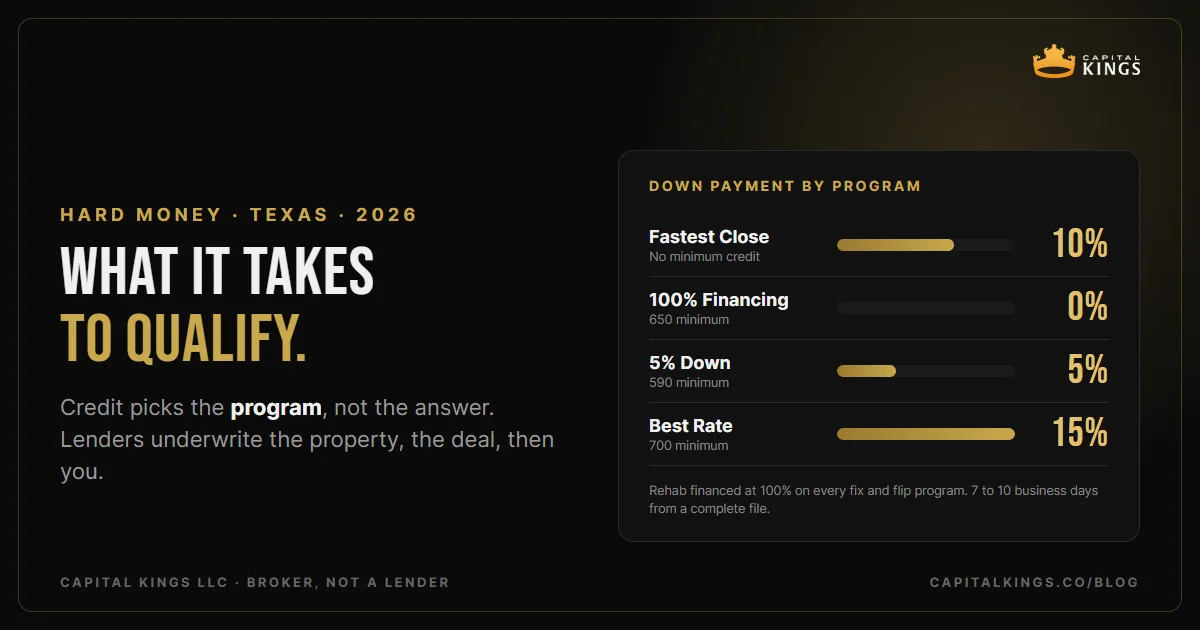
Hard money is easier to qualify for than a bank loan, and harder than the ads make it sound. The lender looks at the property first and you second. That's why a first-time flipper with a 620 score can close in Houston in nine days, and a borrower with an 800 score can still get turned down when the numbers don't work. Here's everything a Texas hard money lender actually checks, with the numbers from the programs I broker every week.
Quick answer. For a Texas hard money loan in 2026, you need an investment property (1 to 4 units, not a home you live in) that's worth enough after repairs to support the loan. Most programs want a credit score of 590 or better, and some have no minimum at all. You'll put 0% to 15% down depending on the program, plus cash for closing costs and reserves. For paperwork, plan on a Texas LLC, the purchase contract, a line item rehab budget, two months of bank statements, ID and builder's risk insurance. Once your file is complete, most loans close in 7 to 10 business days.
What the Lender Is Actually Underwriting
A hard money lender checks three things, in this order: the property, the deal, and then you. The property comes first because it's the collateral, the thing the lender takes back if the loan goes bad. That's why the after repair value and your exit carry the most weight, whether you plan to sell or refinance. The deal is the math: purchase plus rehab, compared to the ARV. You're the last check. That covers your credit, your experience, and whether the cash you need is really sitting in your account. Banks run that list backwards, which is why they take 45 days and say no more often.
Credit Score Requirements
Your credit score doesn't really decide whether you get the loan. It decides which programs you can use and what they'll cost you, and my term sheet breaks it into five bands:
| Credit band | What it opens |
|---|---|
| 760 and up | Every program. Best Rate from 8.99% with 15% down, 0.5 points. |
| 700 to 759 | Best Rate and the 10% down option at 9.99%. Plus every lower-down program. |
| 660 to 699 | 5% down from 9.99% (experience moves the rate here), 100% financing at 11.75%. |
| 600 to 659 | 5% down program (590 minimum), with the rate set by experience. Fastest close with 10% down. |
| Under 600 | Fastest close program (no minimum credit, 10% down, 11.99%, 6 month term). |
Two things trip people up here. A 700 score doesn't automatically mean less cash at closing, because the best-rate programs want 15% down and the 5% program doesn't. And hard money lenders care more about what's on your credit report, like judgments, unpaid liens and recent foreclosures, than about the score itself.
Experience Requirements
You don't need experience to qualify. The programs sort your completed deals into four tiers: first deal, 1 to 3, 4 to 10, and more than 10. Experience only changes the rate if your credit is in the 600 to 699 range, where a fourth completed flip can be worth a full point. Above 700 or below 600, every tier gets the same rate. New construction is different. There, the number of builds you've finished sets how much you can borrow, from 85% of cost and 65% of value on your first build up to 90% of cost and 75% of value after five.
Down Payment and Leverage by Program
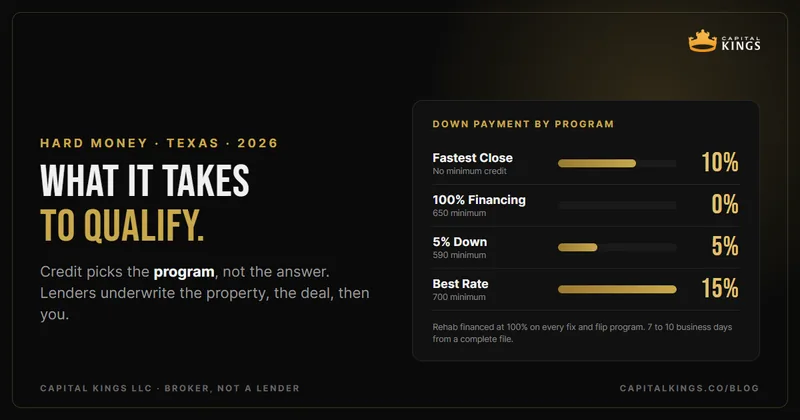
On every fix and flip program, the rehab budget is financed at 100% and paid out in draws as the work gets done. Your down payment only applies to the purchase price.
| Program | Min credit | Down | Rate | Points | Cap | Close |
|---|---|---|---|---|---|---|
| Best Rate | 700 | 15% | 8.99% to 9.49% | 0.5 | 75% of ARV | 14 days |
| 5% Down | 590 | 5% | 9.99% to 12.99% | 2 | 75% of ARV | 14 days |
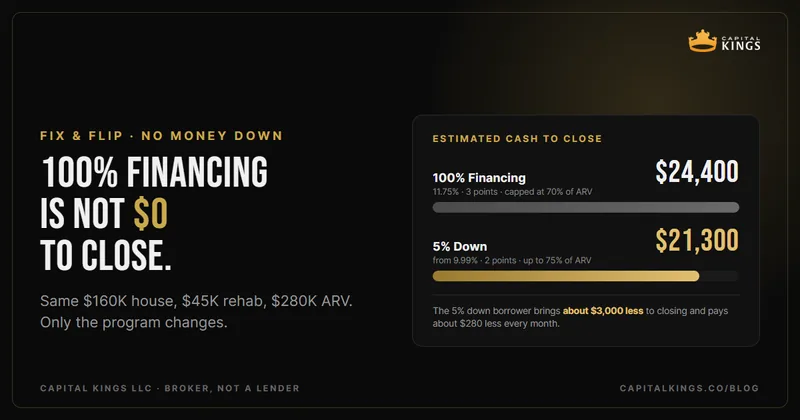
| 100% Financing | 650 | 0% | 11.75% | 3 | 70% of ARV | 14 days |
| Fastest Close | none | 10% | 11.99% | 2 | 90% of cost, 75% of ARV | 72 hours |
| New Construction | 650 | 10% to 15% | 9.99% to 11.49% | 2 | 85% to 90% of cost | 21 to 30 days |
| DSCR Rental | 660 | 20% | qualifies on rent | 2 | 80% of value | 21 to 30 days |
The 0% and 5% down programs are only available in the major metros: Houston, Dallas, Austin and San Antonio, generally within 30 to 40 miles of the core. Rural Texas deals still close, but with more down and a lower cap.
Cash to Close and Reserves
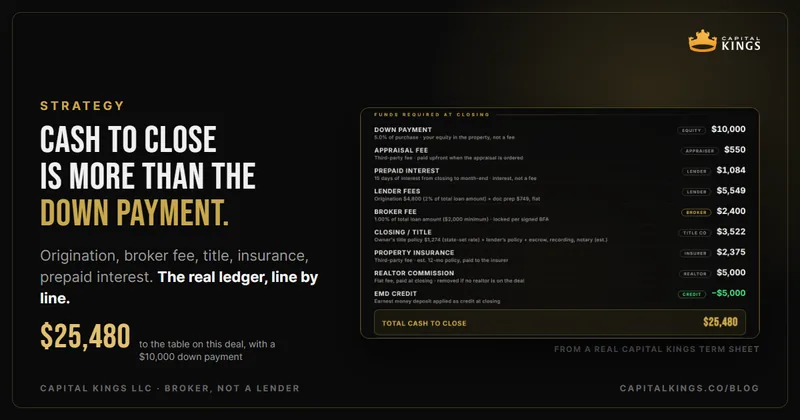
Most first-timers budget for the down payment and forget everything that wires with it: origination, the broker fee, Texas title, builder's risk insurance, the appraisal, doc prep and prepaid interest. The rates guide prices every one of those lines on a sample Houston flip.
Then there are reserves. The proof of funds on my term sheets is cash to close, plus six months of interest on the full loan, plus a share of the rehab budget (about a third on small budgets, about a fifth on large ones). That money stays in your account, but the lender has to see it there. On a $200,000 Houston flip, that usually means $35,000 to $45,000 in verified funds, even when the down payment itself is under $10,000.
Documents You Need
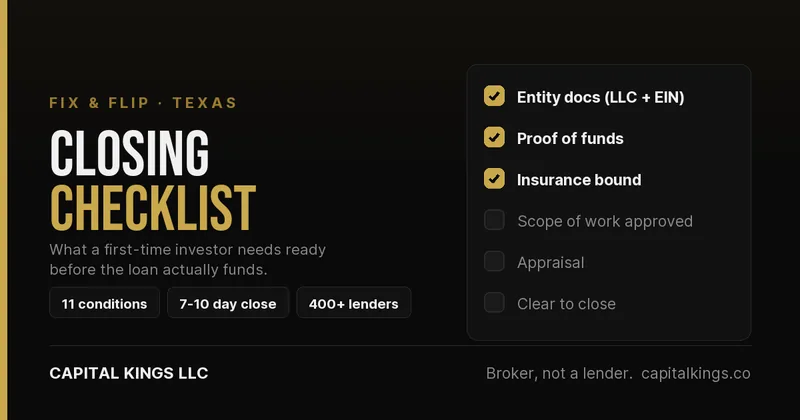
There are six, and three of them are worth finishing the week before you go under contract. Those are the ones with the gold tag.
- Purchase contractSigned by everyone, with every amendment.
- Line item rehab budget Before contractA single lump sum gets sent back, because the lender pays out draws against each line item.
- Bank statementsTwo months, for every account you'll use.
- Government IDFor every member of the entity.
- LLC documents Before contractCertificate of formation, the IRS EIN letter and the operating agreement.
- Builder's risk binder Before contractProof the insurance is in place. The appraisal joins the file once it's ordered.
The lender pulls your credit, so that part isn't on you. Tax returns, W-2s and pay stubs aren't on the list either, because hard money qualifies you on the property instead of your income. If you'd like to tick these off as you go, the fix and flip closing checklist has a version you can tap through.
The LLC Rule
Hard money is business purpose lending, so almost every lender in my network closes the loan in the name of an entity like an LLC instead of in your personal name. Forming a Texas LLC costs $300 with the Secretary of State and takes a day or two. What actually slows closings down are the EIN letter and the operating agreement, and the closing checklist covers both.
Property and Location Rules
- Investment property only. It can't be your homestead or a house anyone in the LLC will live in. Texas homestead law makes hard money on an owner-occupied house a non-starter.
- 1 to 4 units for the fix and flip and DSCR programs. Bigger apartment buildings and commercial property go to different lenders on different terms.
- The value has to support the loan. The math is purchase plus rehab compared to ARV, and the caps in the table above don't bend.
- Clean title. Unpaid liens, mechanic's liens that were never released on a project someone already started, or a seller who can't deliver clear title will stall a closing faster than anything on your side.
How Long It Takes
Seven to ten business days from a complete file is normal. The 72-hour program is there for deals where speed is the whole point, and you pay more for it. The clock starts when the last document from your side is in. Signing the term sheet doesn't start it. That's why it's worth getting your LLC, the insurance binder and the rehab budget done the week before you go under contract.
What Gets a File Declined
- The house is or will be someone's residence.
- The ARV doesn't support the purchase plus rehab under the program's cap, and the borrower can't cover the difference.
- There's no believable exit, like no comps to back up the resale, or a refinance that wouldn't qualify.
- A rehab "budget" that's just one number.
- Reserves that show up in a screenshot but not on a bank statement.
- Title problems the seller can't clear.
Notice what isn't on that list: a low score, a first deal, or self-employment income. Those can change what you pay, but they won't stop the loan on their own.
Find Out Where You Stand in Two Minutes
Capital Kings LLC is a broker, not a lender. You fill out one application, and it gets shopped across 400+ lenders in my network. Before anyone calls you, the instant term sheet shows the program, the rate, the down payment, every fee and the cash to close for your actual deal. The application only asks for your estimated credit score, and there's no credit pull to see any of it.
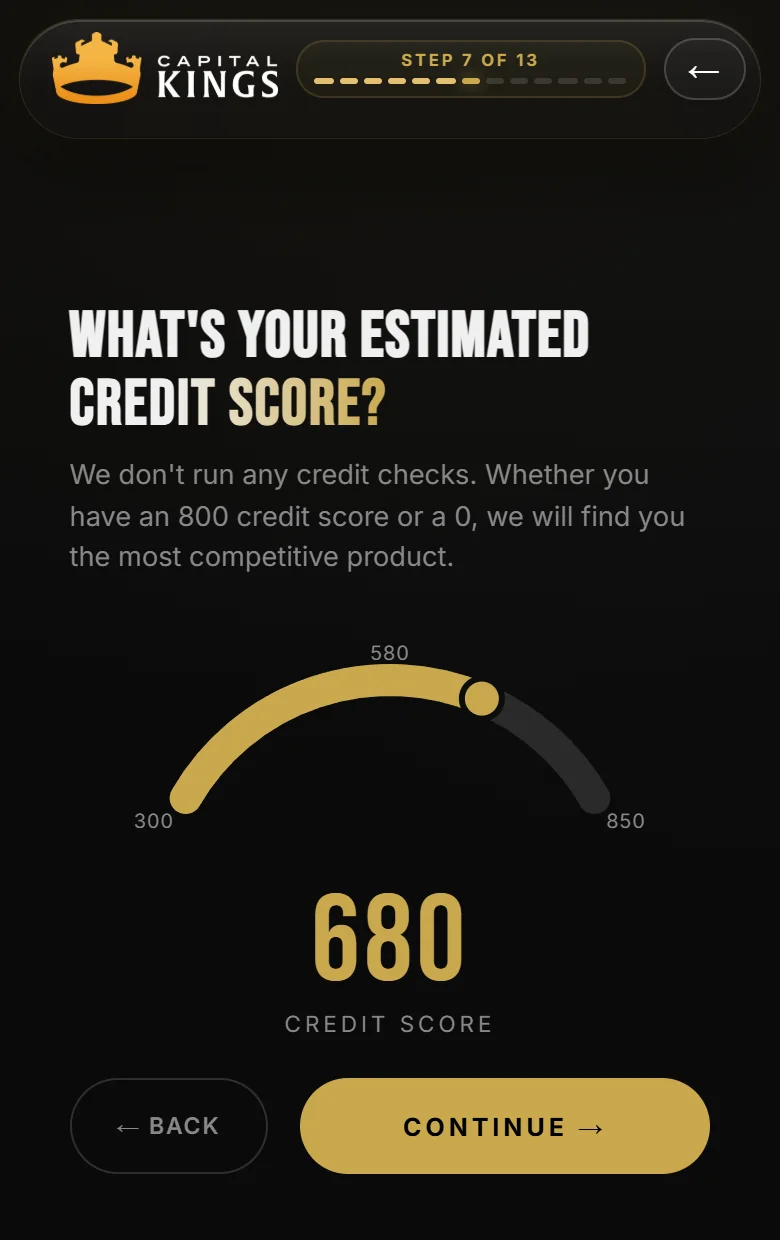
If you've got a property under contract, start your application and pick I Have A Property. If you're still shopping, pick Quick Pre-Approval on the same page instead. That calculator shows you what purchase price your cash can support.
Frequently Asked Questions
What credit score do you need for a hard money loan in Texas?
How much do you have to put down on a hard money loan?
Do I need experience to get a hard money loan?
Do I need an LLC for a hard money loan?
How much cash do I need to close a hard money loan?
How fast can a hard money loan close in Texas?
What disqualifies a property from hard money financing?
Think you qualify?
The programs behind these requirements, with the rate and the down payment for each credit band, are on the fix and flip loan page. If you'd rather just see your own numbers, the instant term sheet takes about three minutes and doesn't pull your credit.
Get my instant term sheet