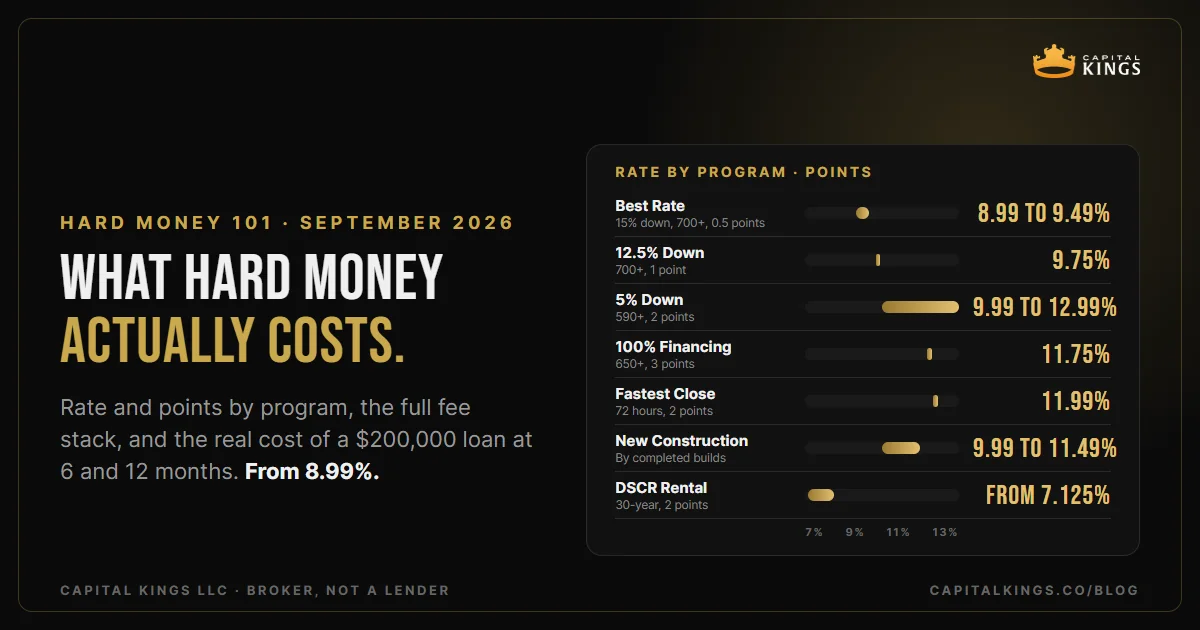
Rate is the first question every investor asks me, but it's the last number that should decide the deal. A hard money quote is a rate, origination points, term length, a down payment and a stack of closing fees, and lenders love to show you the interest rate and let you discover the rest at the title company. Here is the whole stack, priced off the programs I broker every week, with the numbers dated so you know how fresh they are.
Rate and Points by Program (as of September 2026)
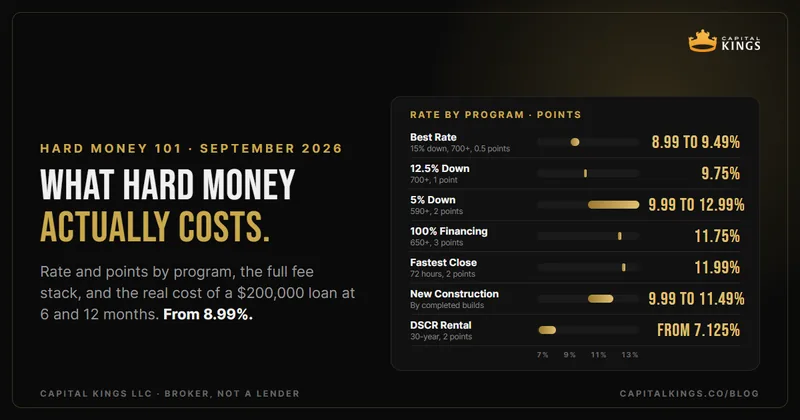
Every rate below is what the instant term sheet actually shows for that program. The rate is fixed for the term, and the hard money programs are interest-only (you pay just the interest each month and the balance when you sell or refinance). Points are the lender's origination fee, charged on the loan amount at closing, with a $2,000 minimum. Each point is one percent of the loan. Experience matters as much as credit, so the last column shows what you'd pay on a first deal and what changes as you finish more of them.
| Program and term | Rate | Origination | Down payment | Min credit | Experience |
|---|---|---|---|---|---|
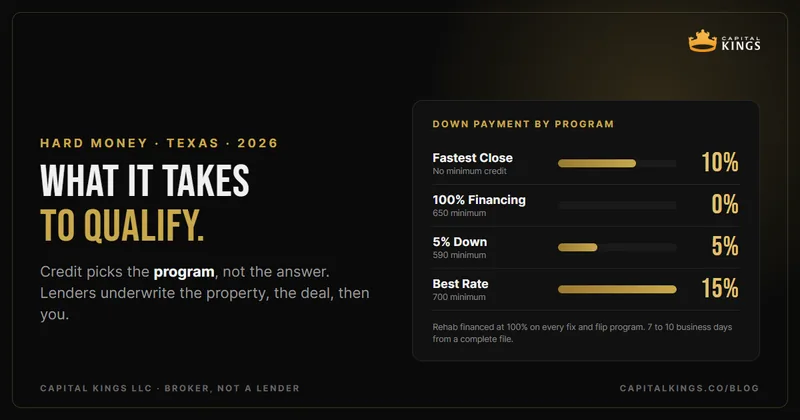
| Best Rate12 months | 8.99% to 9.49% | 0.5 points | 15% of purchase | 700 | A first deal comes in at 9.49% (8.99% at 760+). 730+ credit with 10+ deals gets 8.99% |
| 12.5% Down12 months | 9.75% | 1 point | 12.5% of purchase | 700 | First-time investors get 9.75%. 4+ completed deals drop the down payment to 10% |
| 5% Down12 months | 9.99% to 12.99% | 2 points | 5% of purchase | 590 | First deal qualifies. Every experience tier lowers the rate (grid below) |
| 100% Financing12 months | 11.75% | 3 points | 0%, capped at 70% of ARV | 650 | First deal qualifies. Same price at any experience |
| Fastest Close (72 hours)6 months | 11.99% | 2 points | 10% of purchase | None | First deal qualifies. Same price at any experience |
| Purchase-only (no rehab)12 months | 9.75% to 11.00% | 1 point | 12.5% (15% under 680) | Rate varies by credit | First deal qualifies. 4+ deals at 730+ credit drop the down payment to 10% |
| New construction12 to 18 months | 9.99% to 11.49% | 2 points | 10% to 15% of total cost | 650 | First build 11.49%, 1 to 4 builds 10.49%, 5+ builds 9.99% |
| DSCR rental30-year fixed | From 7.125% | 2 points | 20% to 35% (65% to 80% loan-to-value) | 660 | First rental qualifies. No experience adjustment |
If it's your first deal and you don't want to bring 15%, the 12.5% Down row is the lowest rate you can get: 9.75% at one point with 700 or better credit, on a 12-month term. Ask for the fastest close with 700 or better credit and you get that same 9.75% deal. The 11.99% Fastest Close row is for credit under 700.
On every fix and flip program the rehab budget is financed at 100% and released in draws (payments as the work gets done), so your down payment only applies to the purchase price. Fix and flip loans cap at 75% of after repair value (ARV, what the house is worth once the work is done), and 100% financing caps at 70%.
Purchase-only rates depend on your credit: 9.75% at 730 or better, 10.25% at 700, 10.50% at 680 and 11.00% below that, all at one point. The 0% and 5% down programs are only available in the major metros, Houston, Dallas, Austin and San Antonio, generally within 30 to 40 miles of the core.
What Moves Your Rate
Four things decide where you land inside those ranges: your credit, your completed deals, how much you put down, and how fast you need to close. Most first-time flippers end up on the 5% Down program, and it's the only one where your experience keeps moving the rate as you go. Here's the grid the term sheet uses for it:
| Credit band | First deal | 1 to 3 deals | 4 to 10 deals | 10+ deals |
|---|---|---|---|---|
| 760 and up | 10.99% | 9.99% | 9.99% | 9.99% |
| 700 to 759 | 10.99% | 10.74% | 10.49% | 9.99% |
| 660 to 699 | 11.99% | 11.24% | 10.99% | 10.74% |
| 590 to 659 | 12.49% | 11.74% | 11.49% | 11.24% |
- Leverage. Put 15% down and you move off the 5% Down grid onto the Best Rate program, which is 8.99% at 760 or better and 9.49% from 700 to 759, at 0.5 points. Put nothing down and the leverage costs you 11.75% with 3 points and a 70% ARV cap.
- Speed. The 72-hour close is 11.99% with 2 points on a six-month term and no minimum credit score. The higher price is what it costs to move that fast: the lender does a virtual inspection, skips the credit check, and has one or two people make the call instead of a committee.
- Experience. You don't need any to qualify. After that, finished deals pay off in three places: the 5% Down grid above, the 12.5% down payment dropping to 10% at four completed deals, and the new construction tiers further down.
The Fee Stack: What Wires at Closing
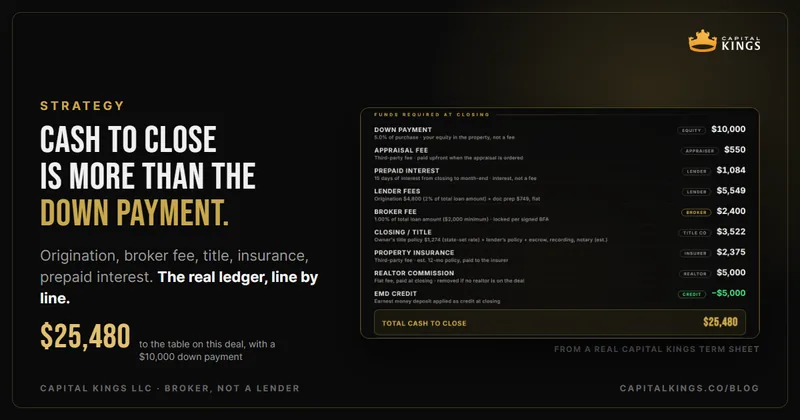
Points are the fee everyone knows about, but they're not the only one. Here's everything that wires at closing on an example Houston flip, using round numbers: a $160,000 purchase, a $48,000 rehab, a $280,000 after repair value, and a first-time investor with 700 credit on the 5% Down program. The term sheet comes in at 10.99% with 2 points and a $200,000 loan (95% of the purchase plus all of the rehab), which is 71.4% of ARV.
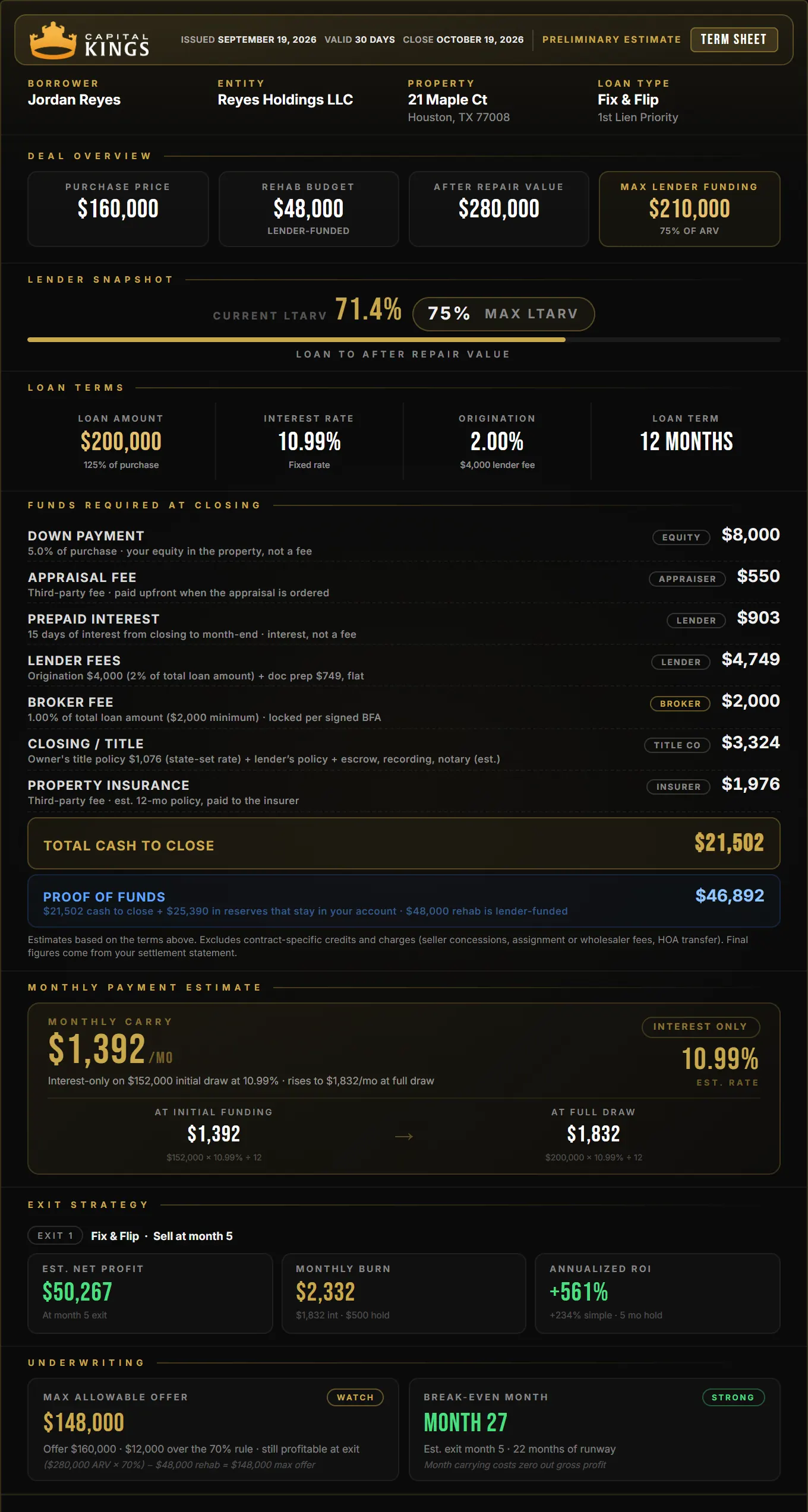 Open the full term sheet →
- Down payment5% of the purchase priceEquity$8,000
- Appraisal feeEstimate on the instant sheet, the lender's actual fee on the final sheetAppraiser$550
- Prepaid interest15 days at 10.99% on $200,000, closing date to month endLender$903
- Lender feesOrigination, 2 points on $200,000 with a $2,000 minimum, is $4,000. Document prep is a flat $749.Lender$4,749
- Broker fee1% of the loan, $2,000 minimumBroker$2,000
- Closing / titleOwner's policy $1,076, lender's policy $298, escrow, recording and title services $1,950Title co$3,324
- Property insuranceBuilder's risk, 0.95% of purchase plus rehab per year, $800 minimum, until the binder is quotedInsurer$1,976
The gold broker line is the only money Capital Kings earns. Proof of funds is the cash to close plus $25,390 in reserves that stay in your account.
Sample term sheet for this exact example with a fictional borrower, generated by the same engine as the application. It carries no realtor commission or earnest money credit; the $5,000 realtor line is explained below.
A couple of things on that sheet are worth slowing down for. First, Texas title isn't a percentage of the loan. The state sets the premiums for the owner's and lender's policies, so every title company charges the same amount, and the term sheet figures title from the purchase price and loan amount instead of guessing 1%. Second, the minimums matter on small loans. Origination and the broker fee both have a $2,000 minimum, so a $120,000 loan pays $2,400 in points and $2,000 to the broker instead of $1,200. On top of all that, the lender checks your reserves. Cash to close, plus about six months of interest, plus a share of the rehab budget has to be sitting in your account, even though it doesn't leave it.
If a realtor or wholesaler brought you the deal. Every fix and flip and purchase-only term sheet you generate on the site includes a flat $5,000 realtor commission line by default. It's paid at closing to the agent or wholesaler who sent the investor. If you're a partner, your $5,000 is already built into the term sheet the borrower sees, on every deal that comes through the site. See the partner program and the $500 referral fee for the rest of how partners get paid. If you're a borrower with no realtor, the line comes off. Remove it yourself in the Deal Analyzer inputs, or ask me and I'll take it off, and the flip closes $5,000 cheaper. Refinance and cash-out sheets never have that line. Any earnest money you already paid shows up as its own credit at closing. It's a separate line and doesn't offset the commission.
Why the Capital Kings Term Sheet Is All-Inclusive
Some lenders charge an appraisal fee and some don't. Some charge processing or extension fees and some don't. A rate quote won't tell you any of that. Our term sheet shows every fee for the lender you're matched with, so the cash to close on it is a real number you can plan around. Here's where each line comes from:
- Appraisal. The instant term sheet on the website uses a $550 estimate. On the final sheet for your lender, if they don't charge an appraisal fee the line says so, and if they do, it shows their actual fee.
- Prepaid interest. This is interest from your closing date to the end of that month, on the full loan. The application asks for your closing date, and until you pick one the sheet assumes 15 days. Close on the 3rd and you prepay most of a month. Close on the 28th and you prepay a few days. If the date moves, the sheet recalculates.
- Lender-specific fees. Processing, underwriting, draw fees, extension fees, exit fees and the loan term all show up line by line, based on what that lender actually charges, so you won't find a fee on the sheet that your lender doesn't collect.
- Broker fee. 1% of the loan, $2,000 minimum, listed right alongside everything else. It's what I get paid for shopping your deal across 400+ lenders, and you see it before you sign anything.
What a $200,000 Loan Costs at 6 and 12 Months
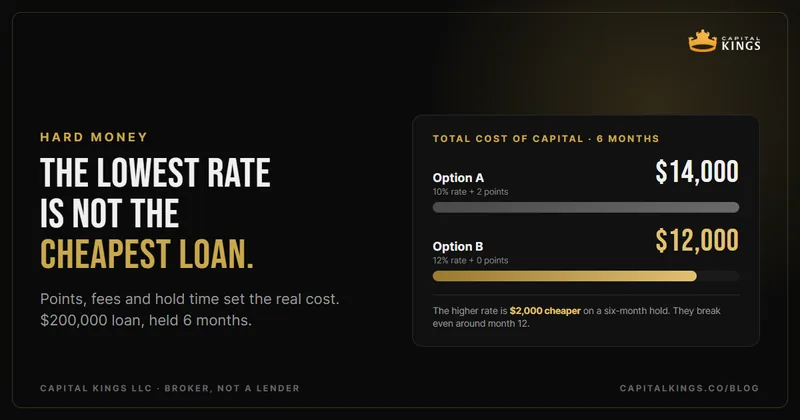
You pay points once, but you pay interest every month you hold the loan. That's why a lower rate with more points wins on a long hold and loses on a short one, which I covered in how to compare hard money lenders. Here's what a $200,000 loan costs in lender charges (interest plus origination) at each program's rate, counting interest on the full balance from day one:
The broker fee, title, insurance, the appraisal and prepaid interest come on top of every one of these, and they barely change from one program to the next, so you can compare the programs straight across. Holding the loan one extra month costs $1,498 to $2,165 at these rates. That's about the whole $2,000 difference in points between Best Rate and 5% Down.
The catch? The Best Rate row is the cheapest money on the table, but it also takes the most cash to get into, because it wants 15% down. On the $160,000 house above, that's $24,000 at closing instead of $8,000, and the loan shrinks to $184,000. If that $16,000 is the difference between doing one project and doing two, the 5% Down program at 10.99% is often the better deal, even though its rate is two full percentage points higher. A lower rate saves you money on this deal, but keeping cash free is what lets you take on the next one. The term sheet shows you both so you can decide.
Dutch Interest or Standard: Ask Before You Compare
The table above charges interest on the whole $200,000 from day one. That's how a Dutch interest loan works, and it's the worst case. On a standard interest loan you only pay interest on what's been drawn so far: the purchase money at closing, then each rehab draw as it's released, so the early months cost less. Every loan I place for a borrower is standard interest. Two lenders can quote the same rate and end up thousands of dollars apart on this one detail, so always ask which one you're being quoted. The full breakdown is in Dutch interest vs standard interest.
DSCR Rental Rates
Rental loans qualify on the property's rent instead of your income, and there's no program list. The rate depends on how much you borrow against the value and on your credit. The program itself, with its leverage caps and terms, is on the DSCR loans in Texas page. As of September 2026, here's where the rates on my term sheet start:
| Loan-to-value | Base rate, 760 or better credit |
|---|---|
| 70% or less | 7.125% |
| 71% to 75% | 7.25% |
| 76% to 80% | 7.375% |
Credit below 760 adds to that base rate: 0.125% from 740 to 759, 0.25% from 720 to 739, and 0.50% to 0.75% from 660 to 719. Cash-out adds 0.25%, and 2 to 4 units add another 0.25%. So at 80% loan-to-value, a 760 borrower would pay 7.375% and a 700 borrower would pay 8.125%.
That grid is what my instant term sheet prices from, and a few lenders in my network go lower. They price the strongest files from about 6%, which takes high credit, plenty of equity, rent that clearly covers the payment, and sometimes points to buy the rate down. I shop every DSCR file across the network before you sign, so if one of them beats the grid, you'll see it.
You need at least 660 credit, a DSCR of 1.0 or better (meaning the rent covers the full payment) and a $100,000 minimum loan. The loan carries 2 points. How much you can borrow goes up with your credit: 80% at 700 or better, 75% at 680 and 65% at 660. On a cash-out, each of those is five percentage points lower. Reserves are three months of the payment on a purchase and six on a refinance. How the ratio itself works is in DSCR loans: how rental cash flow replaces your income docs.
New Construction Rates by Completed Builds
Ground-up pricing depends on how many builds you've finished, because the lender is betting on you to finish the house, not just on the dirt. Every tier carries two points, a 12 to 18 month term, and 21 to 30 days to close. The lot advance is the most the lender will lend against the land at closing. The money for building the house itself is 100% held back and paid out in draws as the build goes up.
| Completed builds | Rate | Loan to cost | Loan to completed value | Lot advance |
|---|---|---|---|---|
| First build | 11.49% | 85% | 65% | 70% |
| 1 to 4 | 10.49% | 90% | 70% | 75% |
| 5 or more | 9.99% | 90% | 75% | 80% |
See Your Numbers Before You Call Anyone
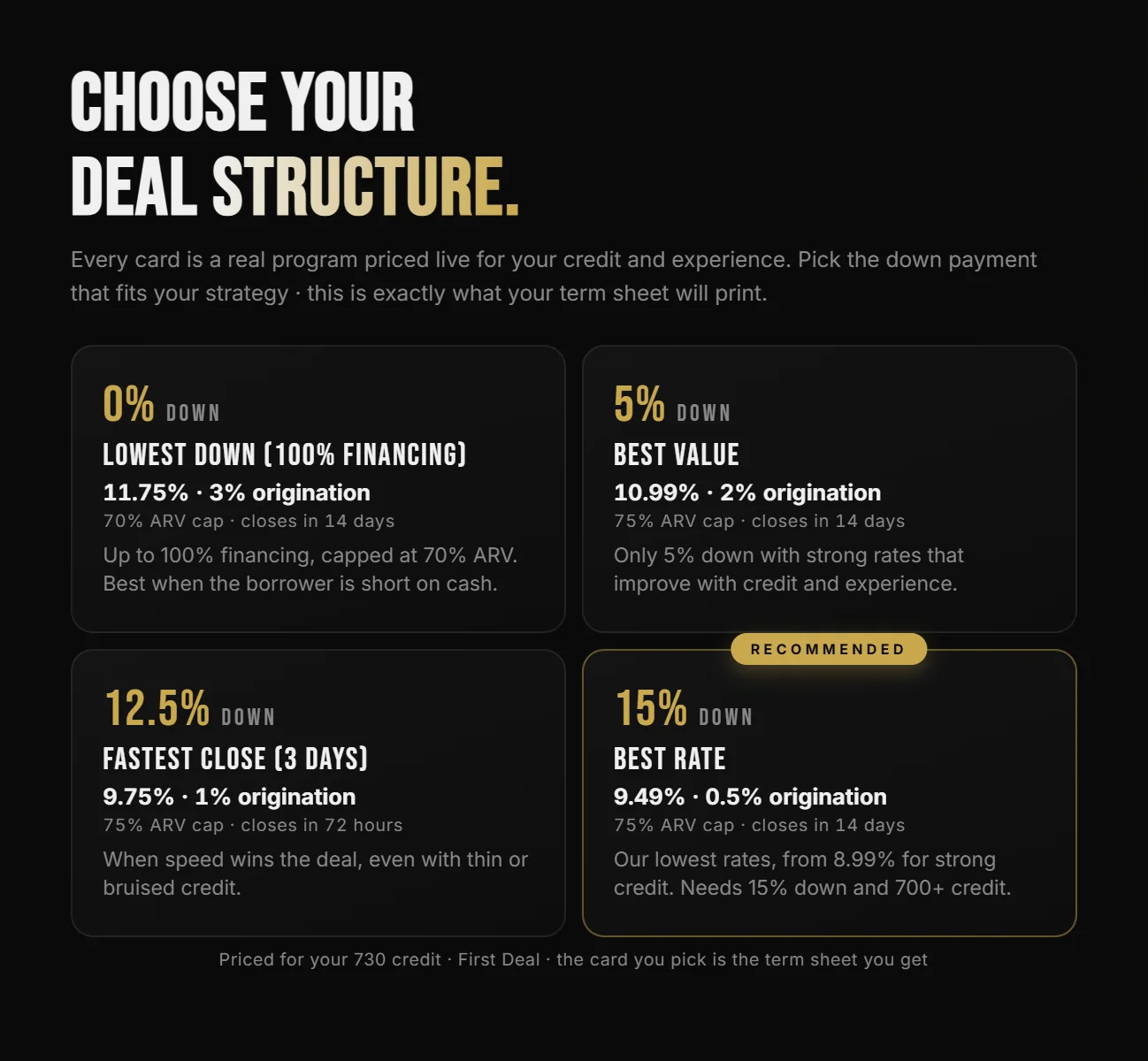
Every number in this guide is dated September 2026 because pricing changes. The easiest way to get today's numbers for your deal is the instant term sheet. Type in the purchase price, the rehab and the ARV, pick the down payment that fits your plan, and in about three minutes it shows you the program, the rate, the points, every fee and your cash to close, with no credit pull.
Capital Kings LLC is a broker, not a lender. Your one application gets shopped across 400+ lenders, and if a lender's own sheet beats what I can put together, I'll tell you. Start at the application, or run the numbers first in the Deal Analyzer.
Frequently Asked Questions
What is the interest rate on a hard money loan in Texas right now?
How many points does a hard money lender charge?
What fees are included in a hard money loan?
How much does a $200,000 hard money loan cost?
Why is there a $5,000 realtor commission on my term sheet?
Does the term sheet include the lender's own fees?
What moves my hard money rate up or down?
Can a first-time investor get these rates?