How It Works
After You Apply
You get an instant term sheet the minute you finish the application. Then we shop your deal across 400+ lenders and fight for the terms. The preliminary terms aren't fake. They're priced at something we know for a fact we can do. Here's the whole process, from application to closing, with the real timelines.
As of September 2026 · 400+ lenders · Broker, not a lender · Business purpose loans only
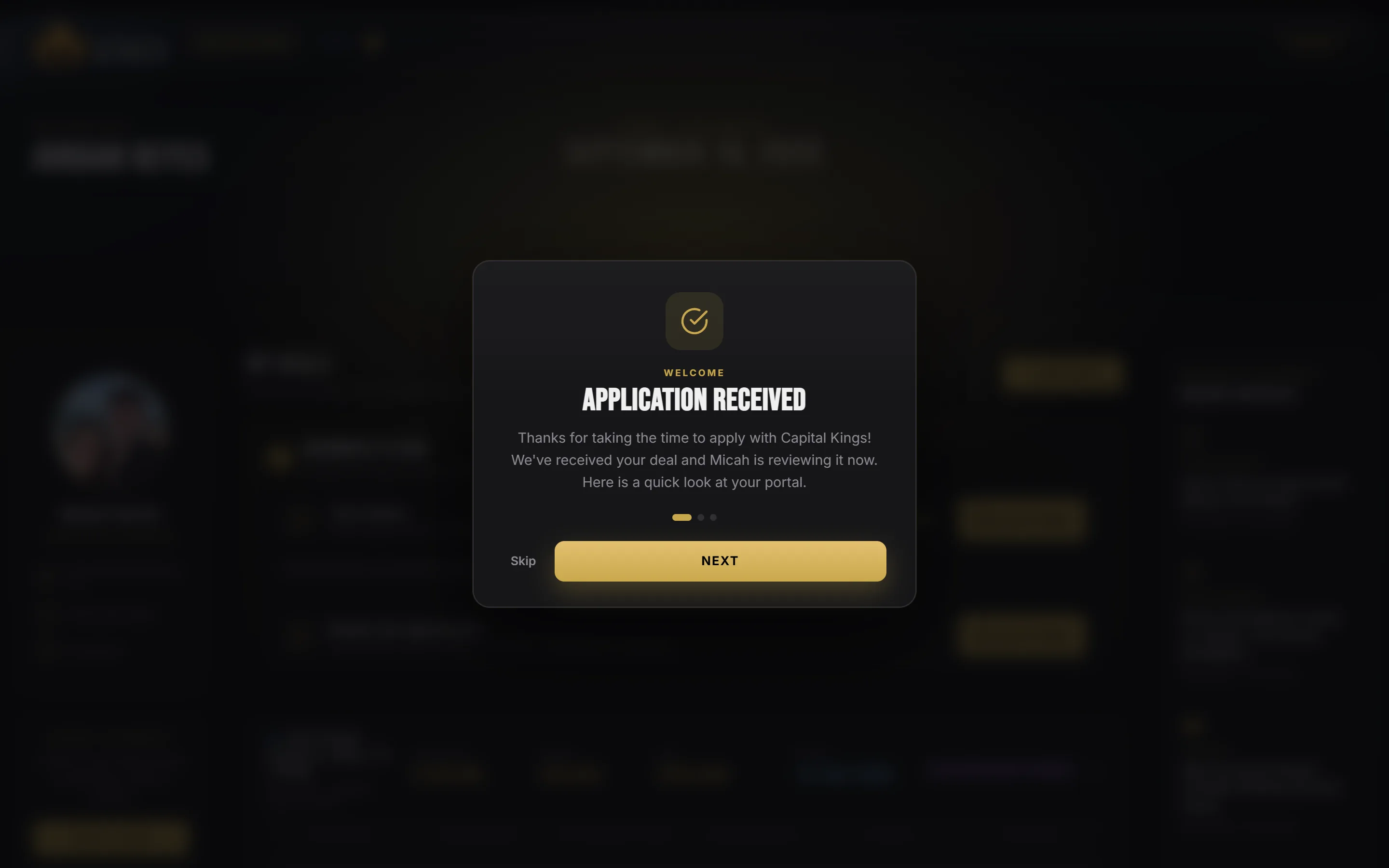
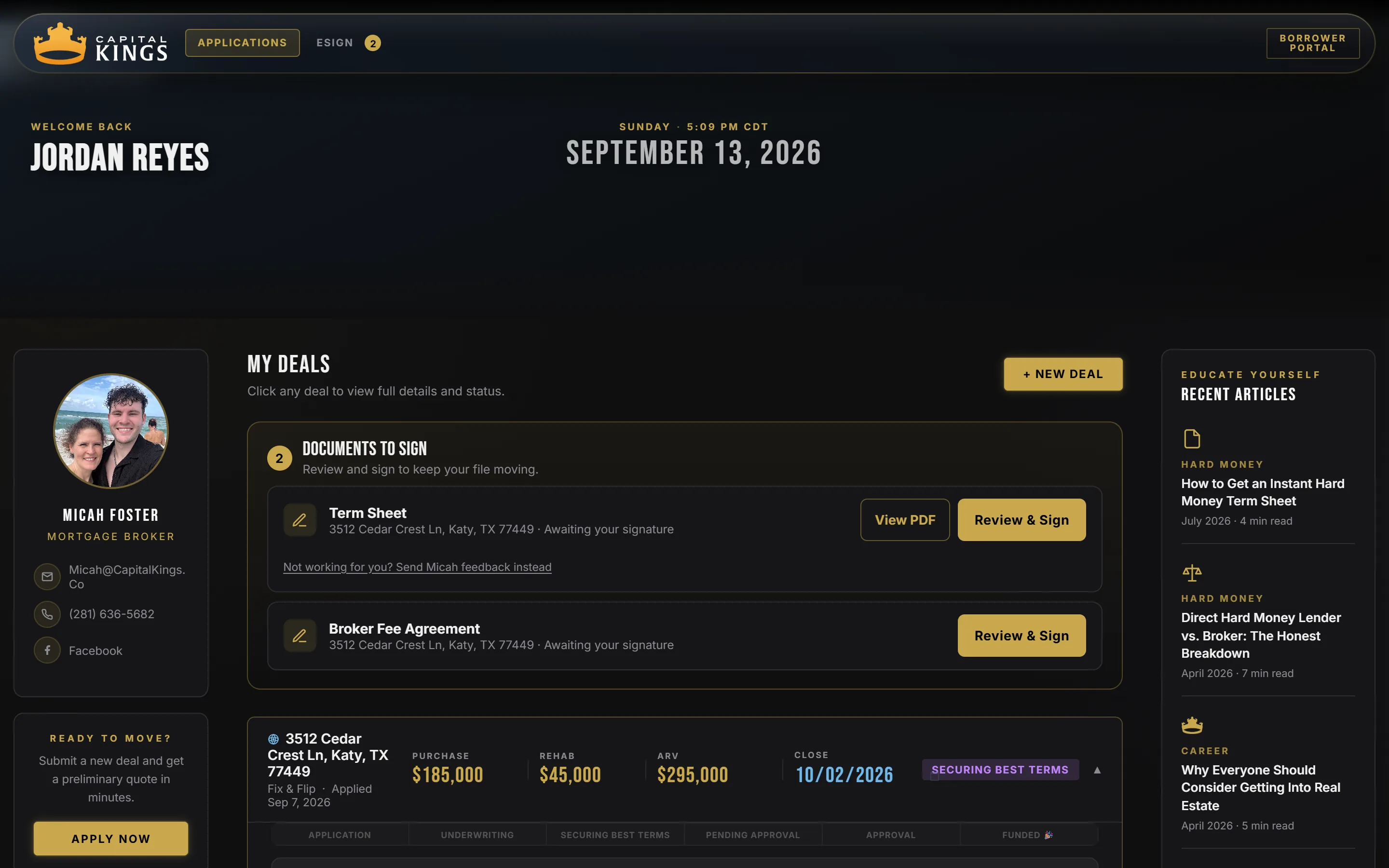
Everything below happens in your borrower portal. These are real screens from a sample deal.
Finish the application and the term sheet is ready before you leave the page. It's priced at terms we know we can deliver, and it's waiting in your portal with the broker fee agreement, both signed in the browser.
The deal card shows the price, rehab, ARV and target close. The stage strip runs from application to funded. The term sheet and broker fee agreement wait at the top until you sign them, and our direct line is on the left.
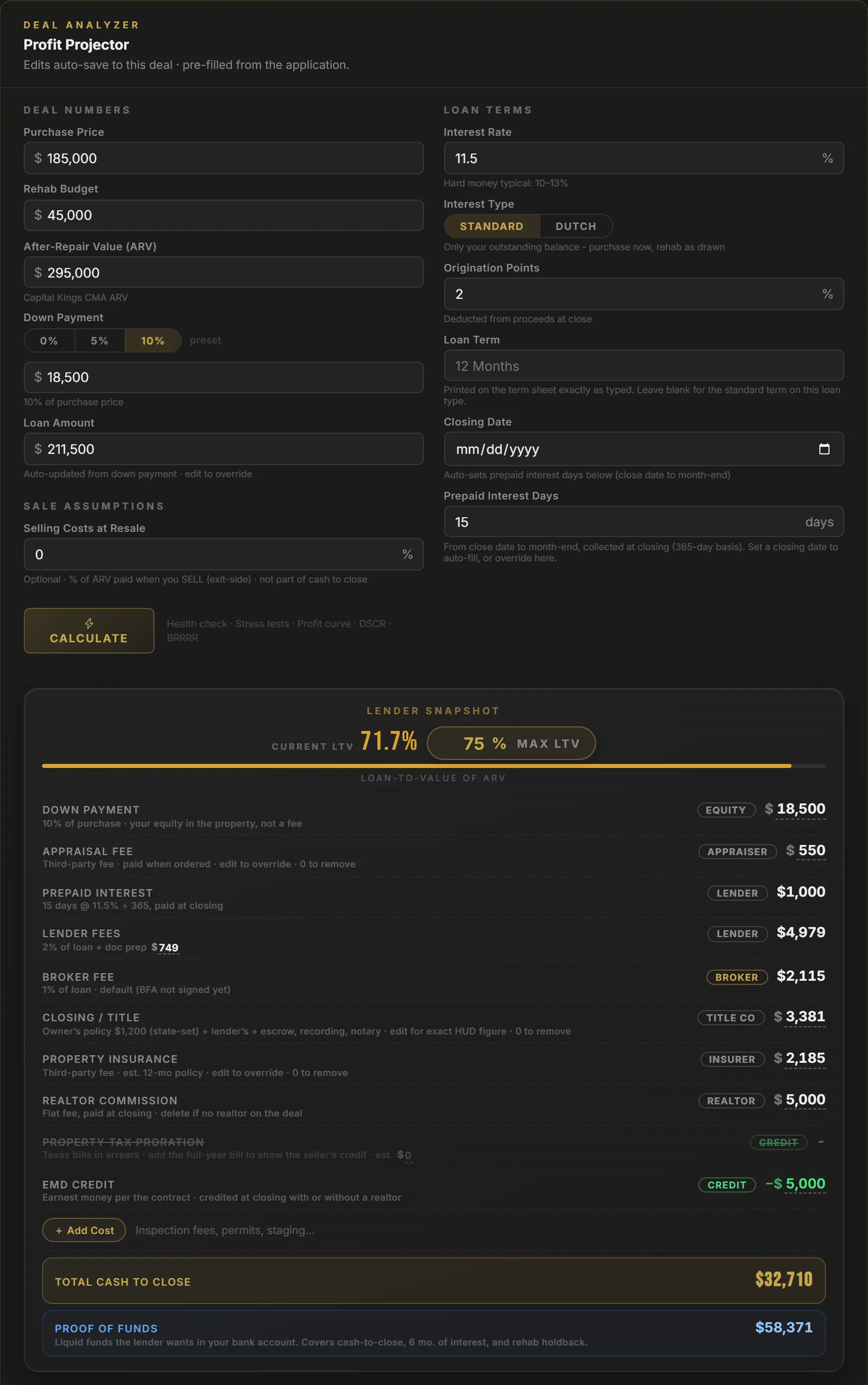
Use the Deal Analyzer to see if the deal works before you make an offer. Adjust the purchase price, rehab budget, ARV, loan terms, and fees, and it automatically tracks your LTV, available loan amount, cash to close, and every fee associated with the loan. You can also see a month-by-month breakdown of your financing costs and projected profit, so you know exactly how the numbers look from purchase through sale.
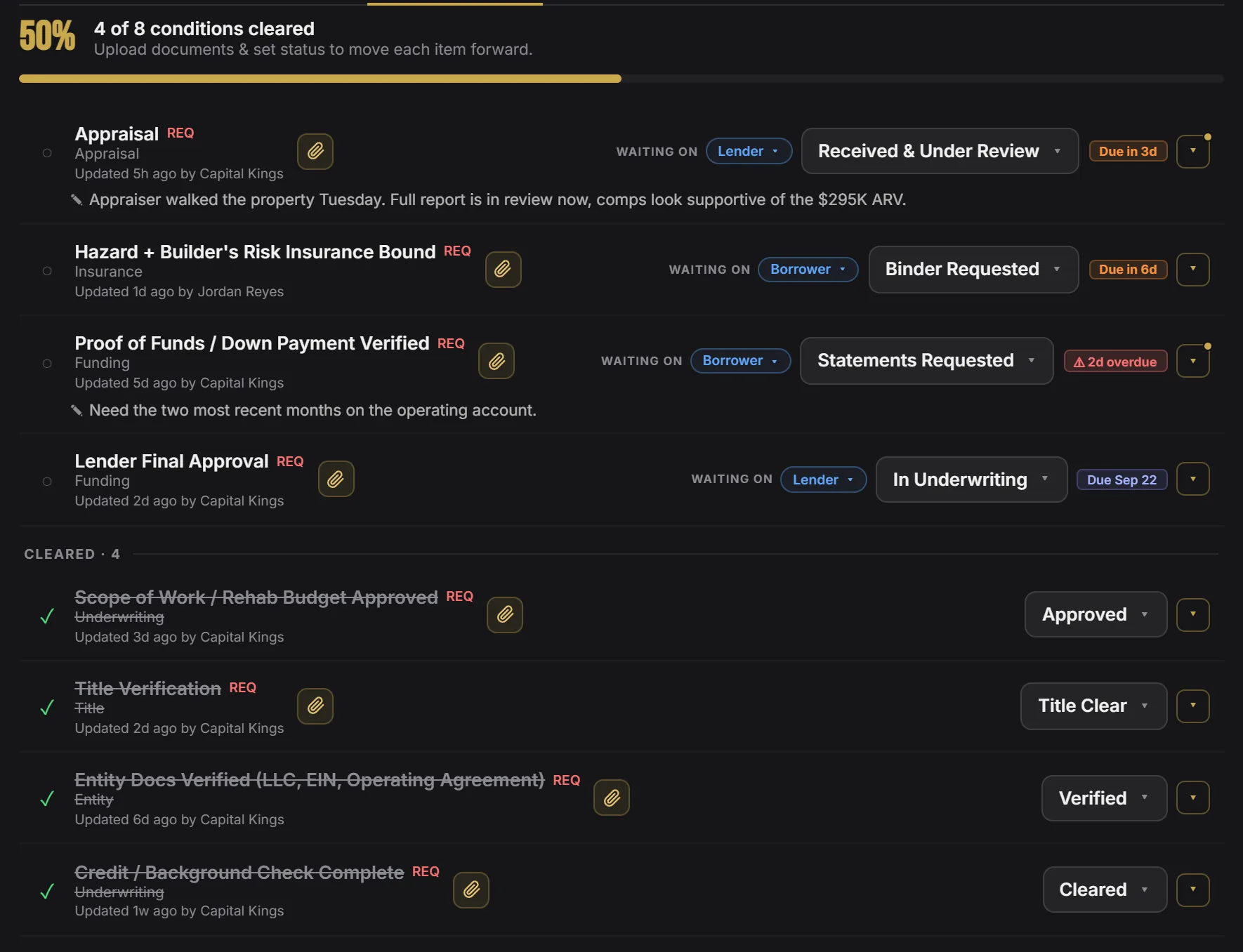
Appraisal, title, insurance, proof of funds, lender approval. Each condition shows who it's waiting on, its status and its due date, so you always know what the holdup is. About two weeks to fund once every document is in.
The term sheet you see when you finish applying is priced at terms we know we can deliver. The only exceptions are a very large loan or an unusual project.
We already hold a matrix of most lenders' terms, and for many of them their entire program grid from their broker portal. So on day one we know who fits your deal. From there we submit through the broker portals, call the reps we know directly, and reach more lenders when your timeline allows.
We present the lender whose terms match your sheet that day, and closing starts as soon as you say yes.
We put lenders against each other and reach the ones whose specialty is exactly your kind of deal.
How much rehab you're planning. The price range you're shopping in, or we tell you the most you qualify for. Your estimated credit score, because credit sets the down payment. Nothing gets pulled for a letter.
Two months of your most recent bank statements, because that's what lenders want at closing anyway. In a hurry? A screenshot of your balance works for the letter and the statements catch up later.
If the three numbers below clear, the letter goes out within about two hours, often one. It's in your LLC's name if you have one, your own name if you don't, and it's free. How the letter works.
Your bank statements have to cover three things, not one. Run yours below.
Your down payment plus the fees on the term sheet: lender origination, our broker fee, title, doc prep, insurance, prepaid interest, and the appraisal if the lender orders one. On 0% down it's just the fees.
Proof you can cover the first few monthly payments. Some lenders want 3 months in the account, some want 6. It stays in your account. It isn't paid at closing.
Fix and flip only: 10% to 33% of the rehab budget, closer to a third on a small budget and closer to 10% on a large one. Draws pay you back after each phase, so you fund the first phase yourself.
Priced the same way as the instant term sheet. An estimate for planning, not a quote.
Cash to close plus six months of interest plus the rehab reserve. The reserves stay in your account. Term sheet defaults: Texas title, insurance at 0.95% of purchase plus rehab, $749 in lender fees, 15 days of prepaid interest, a $550 appraisal on a fix and flip. Get the real number on your deal.
Before you write the offer we pull comparable sales (comps: recent nearby sales of similar homes) and give you our after repair value, the ARV. It matters because the ARV sets the lender's maximum loan, so we show you the cash to close at our number, not just at yours.
The question isn't what the house will sell for. It's what it will appraise for. A house sometimes sells for more than it appraises because the appraiser leans on a weaker comp, and we account for that up front instead of finding out at the appraisal. Our number takes 2 to 3 hours. You can disagree with it and still proceed. We also tell you before you go under contract whether your lender sends out an appraiser or values the property in-house.
Our number, your number, and the middle. Each sheet carries its own loan, down payment and cash to close, so you know what you'd bring in every case before you write the offer. Try it on the deal from the calculator above.
Same purchase, rehab, program and credit as the calculator above.
If the appraisal still comes in low. It's rare on our deals because of the step above. Right on the line, the borrower sometimes brings the difference. Way low, we tell you to walk or renegotiate, and the appraisal report is your leverage with the seller.
Earnest money (the EMD, a deposit that shows the seller you're serious) is typically about $5,000 on the deals we see. It's credited back to you at closing, so it comes straight off your cash to close. The real term sheet further down shows exactly where that credit lands.
Most wholesale deals have no inspection period. The contract you sign is the contract you close on, which is why the comps and the numbers have to be right before you sign it.
Once you're under contract we put the loan file together so the appraisal and any inspection can be ordered. Most of this you already have, and all of it uploads in your borrower portal. Tick them off as you go.
The title company usually comes with the contract, from the wholesaler or the seller. Sometimes you get to choose.
The appraisal is ordered by the lender once the rehab budget is in, because the appraiser values the finished house off your scope of work. Some lenders value it in-house from photos at no cost to you. Some send an appraiser, and you pay that fee when it's ordered. If it meets value, we move to closing.
Same documents, same lender. The only difference is the day the rehab budget is submitted by the borrower.
A 5 to 7 day close is real, and one is below, but it needs everything at the very beginning. Once every document is in, plan on about two weeks to fund, less when the lender values the property in-house.
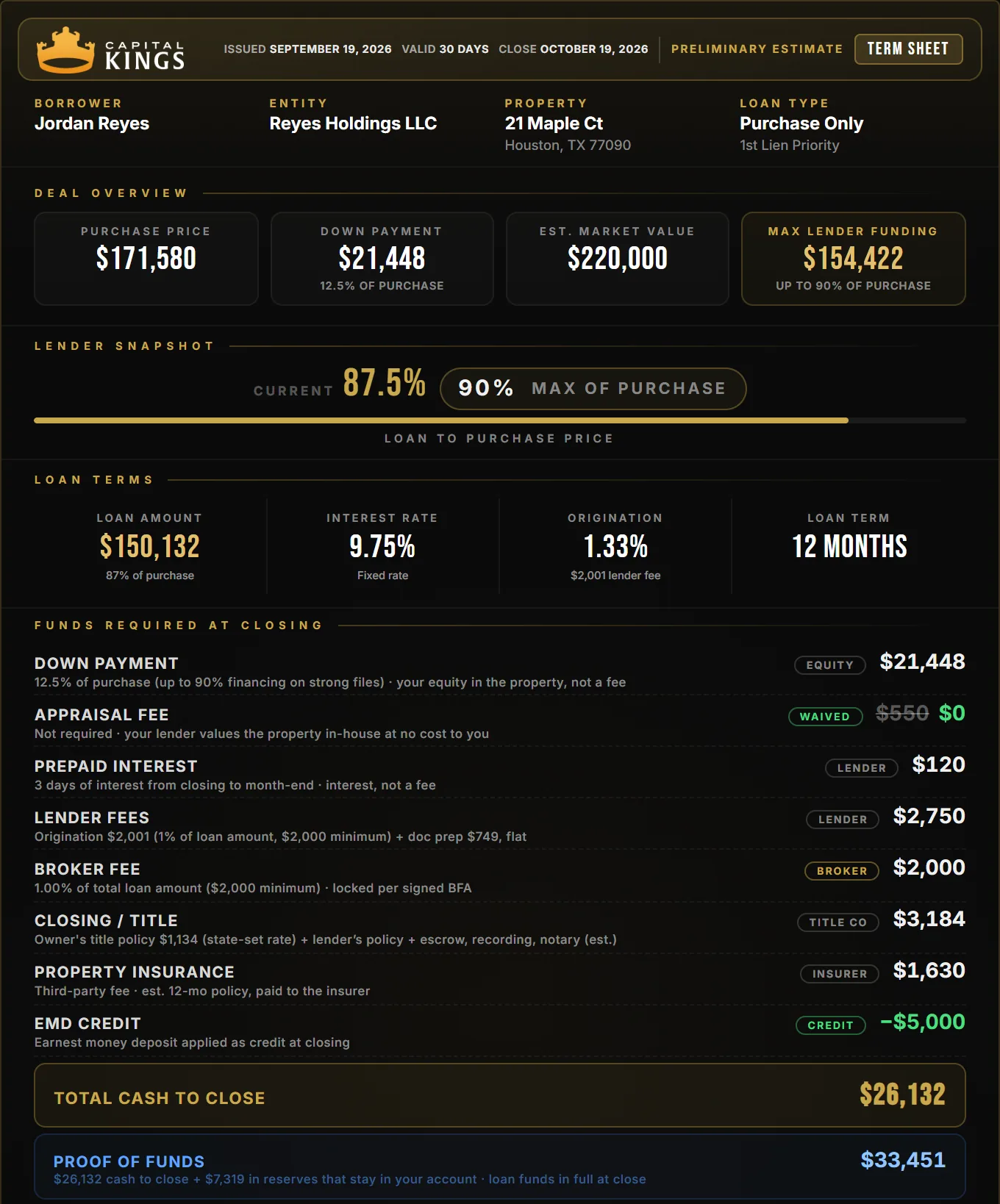
First deal, 740 credit, a single family house bought at $171,580 with no rehab and an estimated value of $220,000. This is the term sheet our engine produces for that deal today, and the dates it actually took.
Loan $150,132 at 9.75% for 12 months, 87.5% of the purchase price and under the lender's 75% of value cap. Standard interest, so you pay on the money that's funded, which on a purchase-only is the full loan from day one.
At the table the seller also credited $4,075 toward closing costs. The sheet doesn't show that, so the borrower actually brought less.
The loan funds in full at closing. A rehab budget isn't always required, though lenders want to know the plan. On a heavy rehab the lender usually wants to fund the rehab too, which makes it a fix and flip. Purchase-only loans.
A rental loan qualified on the property's rent instead of your income. The house is usually rent-ready when you buy it, so there's no rehab reserve. Cash to close and the interest reserve still apply. DSCR loans.
Everything else on this page, the shopping, the three sheets, the document list and the clock, works the same on a fix and flip.
The question I get most isn't about rates. It's "okay, I applied, now what?" The honest answer is that the first hour is easy and the rest depends on how fast you get me the file.
None of this is a secret. It's just what a closing actually takes. Know it going in and the deal above is what yours can look like.
Instantly. The term sheet is ready the moment you finish the application, and the preliminary terms aren't fake. They're priced at something we know for a fact we can do. The only exceptions are a very large loan or an unusual project. From there we present a matching lender right away if you're on a tight timeline, or shop the deal wider if you've given us two or three weeks.
No. We already hold a matrix of most lenders' terms, and for many of them their entire program grid from their broker portal, so on day one we know who fits your deal. More time lets us do two things: put lenders against each other (we've told a lender we were moving forward with someone else and had them match or beat it), and reach the lenders whose specialty is exactly your kind of deal. On a tight close we present the best fit from what we already hold instead of waiting on the slower replies.
About two hours once your bank statements are in, often within one. We get on the phone first to check the property and the program, then ask how much rehab you plan, your price range and your estimated credit score. In a hurry, a screenshot of your bank balance works for the letter and the two months of statements catch up before closing.
Cash to close, which is your down payment plus the fees on the term sheet. An interest reserve of 3 to 6 months of payments, depending on the lender, which stays in your account. And on a fix and flip, a rehab reserve of 10% to 33% of the rehab budget, closer to a third on a small budget and closer to 10% on a large one, because draws are reimbursements and you fund the first phase yourself. Purchase-only and DSCR loans have no rehab reserve.
Typically about $5,000 on the deals we see. It's credited to you at closing, so it comes straight off your cash to close. On the real deal on this page the $5,000 credit is a line on the term sheet, and total cash to close came out to $26,132 after it.
It's rare on our deals because we run comps from an appraiser's perspective before you offer, and when we disagree on ARV we send three term sheets, ours, yours and the middle, each with its own cash to close. If it still comes in low: right on the line, the borrower sometimes brings the difference. Way low, we tell you to walk or renegotiate. The appraisal report is your leverage: the lender is two days from closing, the appraisal came in low, this doesn't work, we need to renegotiate. Sellers often come down.
Your LLC's certificate of formation, certificate of filing and EIN letter, plus an operating agreement if the LLC has more than one member. The signed purchase contract, the rehab budget, two months of bank statements, and builder's risk insurance bound before closing. Some lenders also want a driver's license. The title contact usually comes with the contract. The appraisal can't be ordered until the rehab budget is in.
The clock starts when the last document is in, not the first. LLC documents on day one and the rehab budget on day four means the appraisal waits until day four. Once everything is in, plan on about two weeks to fund, less when the lender values the property in-house. The real deal on this page, a purchase-only loan for a first-time investor in north Houston, was applied for on July 23, shopped on July 24 and funded on July 31, five business days, because the file was complete and the lender valued the house in-house.
No. Capital Kings LLC is a broker. We shop your deal across 400+ lenders and the funding lender sets the final terms after the appraisal, title and a full file review. We earn one broker fee, 1% of the loan with a $2,000 minimum, printed on the term sheet before you sign anything. On the real deal on this page it was $2,000.
Two minutes on the application gets you an instant term sheet priced at terms we can actually deliver. Everything on this page starts from there.
Need a letter for an offer first? Get pre-approved. Want to see the portal your file lives in? Tour the borrower portal.