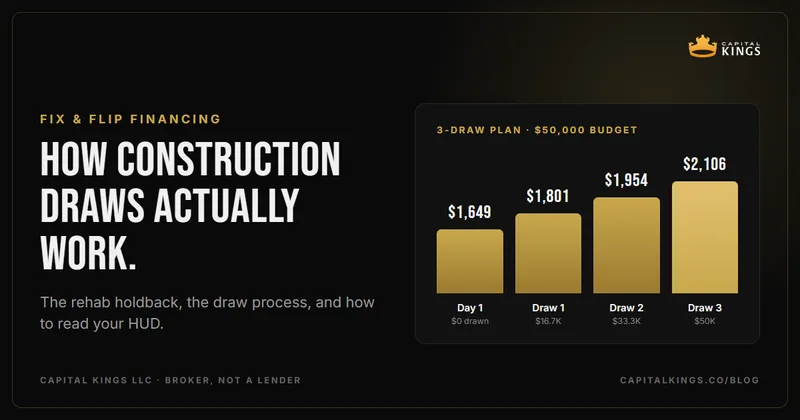
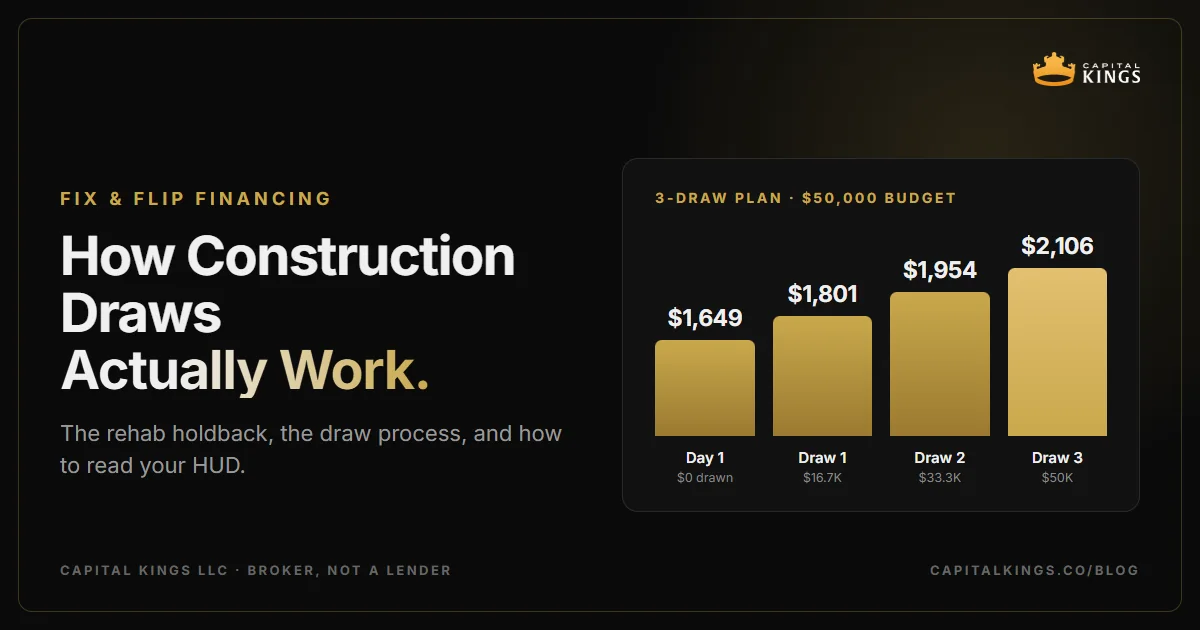
- Your rehab budget isn't funded at closing. It sits in a holdback and gets released in draws, after the work is done and inspected.
- Draws pay you back for work you've already paid for. Lenders only pay for installed work, but most will pay out the finished share of a half-done line item.
- Most lenders charge an inspection fee on each draw, often around $200 (a few charge nothing), and the money usually wires one to three business days after you ask for it. Plan three or four draws instead of a dozen small ones.
I have this conversation early with nearly every new investor I work with. Say your loan gets approved with a $50,000 rehab budget. A lot of first-timers assume that $50,000 lands in their account at closing. It doesn't. It sits in a holdback, basically an escrow account, and you get reimbursed from it draw by draw.
What a Lender Holdback Is
A fix and flip loan has two parts. The first part pays for the property, and that money goes out at closing. The second part is your rehab budget, and none of it goes out on day one. It gets set aside, or held back, which is where the name comes from. You'll hear it called a rehab holdback, a construction holdback, an escrow holdback, or a repair escrow. The paperwork looks different from lender to lender, but it's the same idea: money the lender has committed to your project but hasn't released yet.
You'll see the holdback on your closing statement, but the lender usually isn't wiring that money to the title company ahead of time. It lives in your loan documents as a binding commitment, and it comes out of the lender's own account as you draw. Two other details surprise people. The appraiser gets a copy of your rehab budget and uses it to figure the after repair value (what the house should be worth once the work is done). And the final budget is something you sign at the closing table, along with everything else.
Why Your Loan Amount Looks Bigger Than What Funded
Let's put real numbers to this, using the same deal from my cash to close breakdown. You buy at $200,000 with a $50,000 rehab budget, and you're putting ten percent down on the purchase.
90% of the purchase price
your rehab budget
That split is what confuses people. Your HUD (the closing statement) shows a $230,000 loan, but only $180,000 of it moved at closing. The other $50,000 is yours to draw on as the work gets done.
Why Do Lenders Do It This Way?
Think about it from the lender's chair. On our deal, you put $20,000 down and the lender commits a $50,000 rehab budget. If they handed you that $50,000 at closing, they'd have wired out more than twice the cash you put into the deal, and nothing but your good intentions would stop you from walking away with it. Draws exist so the lender's money only goes out after the work is done. It's not personal, and it doesn't mean they doubt you. They set up every rehab loan this way because it's how they keep their money safe.
The Draw Process, Step by Step
Draws work as reimbursement. You pay for the work first, then the lender pays you back. Here's one full cycle, with each step in a little more detail after it.
- You finish a phase of work. Demo, roof, HVAC, whatever's on your approved scope of work. You or your contractor pay for it out of pocket.
- You submit a draw request. Most lenders have a portal or a simple form. You point to the line items on your approved budget and attach photos, invoices, and receipts.
- The lender checks the work. Some lenders send an inspector, either someone on their own payroll or a third-party service like Inspectify. More and more have gone virtual. Of the lenders I work with, roughly sixty percent now check draws through photos you send in, and about forty percent still send someone out in person.
- The draw is approved against your budget. The lender releases money for the line items that are finished. You don't get an advance on the next phase or a nice round number, just what the finished line items add up to.
- The money wires to you. A request with clear photos and receipts usually goes through quickly. One that's missing something waits until you send it.
From request to money in hand, one to three business days is typical, assuming the work is finished and your paperwork is clean. Plan your contractor schedule around that gap, because your electrician doesn't care that your draw is still processing.
Most lenders won't cap you, either. There's no minimum draw amount and no limit on how many draws you take. You could request one every week, but I wouldn't.
You Front the Work. Plan for It.
Since draws pay you back after the fact, lenders want to see rehab reserves (cash you have on hand for the work) before they close, usually somewhere between twenty and thirty-three percent of your budget. It isn't red tape. The lender is really asking one question: can you pay for phase one before the first draw pays you back?
It's also where a lot of first flips stall. Most contractors want a deposit up front, and draws only pay you back for finished work. So the deposit goes out today and the reimbursement comes in next week, and most new investors don't see that gap coming. If cash is tight after closing, start with a phase that's cheap to do and easy for an inspector to sign off on. Once that first draw pays out, put the money toward the next phase, and the cycle keeps itself going from there.
One more thing, since people ask me: none of the lenders I work with advance rehab money before the work is done. If you want cash up front to run your own rehab, that's a different product, closer to a cash out refinance.
Build In a Contingency (Some Lenders Will Force You To)
About half the lenders I work with require a ten percent contingency line (a cushion for surprises) in the rehab budget, and some of them will just add it themselves if your budget shows up without one. The other half don't require it at all. Either way, I tell every investor the same thing: build the ten percent in yourself. Nearly every project runs over somewhere, even the well-planned ones. If the contingency is already in the budget, that overrun is already financed, so it doesn't come out of your pocket halfway through the project.
What Draws Cost
Lenders rarely bring up draw fees on their own, so ask for the draw fee schedule before you sign. What you pay depends on the lender. Most charge an inspection fee of roughly $150-$400 per draw, with $200 the most common. A few don't charge anything, and some add a wire fee on top. At $200 a draw, a project with four draws pays $800 before any wire fees.
Materials on Site Do Not Count (But Partial Work Does)
I explain this one to nearly every first-time investor. Lenders reimburse installed work. If you have a garage full of cabinets and a lumber package sitting in the driveway, you can't draw on that yet. It doesn't count until it's part of the house.
Partly finished work is a different story. Say you have $4,000 budgeted for paint, and the downstairs is done but the upstairs isn't. Most lenders will do a partial reimbursement and pay for the part that's done, so roughly $2,000 in that example. I'd put that at over eighty percent of the lenders I work with. You don't have to wait for a line item to be one hundred percent complete to get paid on it.
Your Rehab Budget Has to Be Market Pricing
Investors who double as contractors run into this one a lot. A lot of times they'll build a budget where they do the labor themselves and only count materials, so it comes in around $40,000. Then the lender pushes the budget to $60,000. They're surprised, sometimes annoyed, until I explain why.
The lender figures your rehab cost as if a contracting company had to do the work. That's because they plan for the case where the borrower defaults and they take the property back, and in that case a contracting company will have to do it. So they need the full market cost of finishing the project built into the loan, and into their loan-to-value math, from day one.
Once contractor-investors see it that way, most of them like it. The budget has room to pay yourself market rate for your own labor, so the rehab becomes another job you're getting paid on. And since the appraiser factors that budget into the after repair value, an honest budget at market prices helps your appraisal instead of dragging it down.
How to Read the HUD (And Why Everyone Still Calls It That)
Quick history, because the name confuses people. The HUD-1 was the settlement form nearly every closing in America used for decades, until the CFPB replaced it with the Closing Disclosure for consumer mortgages in 2015. A hard money loan to your LLC is different. It's a business-purpose loan, so it's exempt from those rules. That's why investor closings still use a HUD-1 style statement or, more often these days, the ALTA Settlement Statement. Investors just call all of them "the HUD."
Whichever version lands in your inbox before closing, read it top to bottom the same way:
- The header. Parties, property, lender, and two dates that matter: the settlement date and the disbursement date.
- The financial section. The purchase price, your earnest money coming back to you as a credit, and the loan amount. This is where you'll see the full $230,000, holdback included.
- Loan charges. Origination points, the broker fee, prepaid interest, and any lender processing fees, each on its own line. Every one of these should already be on your term sheet.
- Title and escrow charges. Title insurance, the escrow or settlement fee, and recording fees.
- Prorations. Property taxes and anything else split between you and the seller based on the closing date.
- The last line. "Due from Borrower." That's your cash to close, and it should match what your lender or broker told you.
Before you wire a dollar, check three lines: the total loan amount, what the lender is actually funding at closing, and the balance due from borrower. On a rehab loan the first two won't match, and the difference between them is your holdback. If any number doesn't match your term sheet, call before you sign, not after.
Interest on the Holdback (And Why You Might Not Draw It All)
On a standard interest loan, the holdback works like a line of credit. You only pay interest on what you've actually drawn, and nothing on the rest. That gives you some real options. If you finish a $4,000 paint line for $3,000, you can draw the full $4,000 and keep the difference as payment for your work, or draw just the $3,000 and pay interest on less. Some of my investors wait months into a project before their first draw, and a few never touch the holdback at all. The loan already got them into the deal with less cash down, and they'd rather fund the rehab themselves than pay interest on borrowed rehab money.
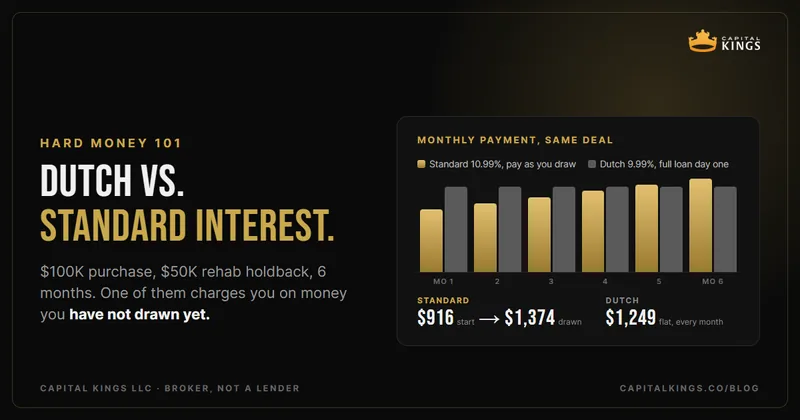
The structure that takes that flexibility away is called Dutch interest. With Dutch, you pay on the full loan amount from day one, including holdback you haven't touched. I wrote a full breakdown with the side-by-side math in Dutch interest vs. standard interest. For what it's worth, I've never once placed a Dutch loan. Every loan I've brokered has been standard interest. I'd only recommend Dutch in one rare case. If you're an experienced investor and you know for a fact the rehab will be done in two months or less, you can take the lower rate Dutch loans usually carry, get in, and get out. If you're newer, or the rehab could run long, standard interest protects you. Finish under budget or ahead of schedule and you save money just because you picked it.
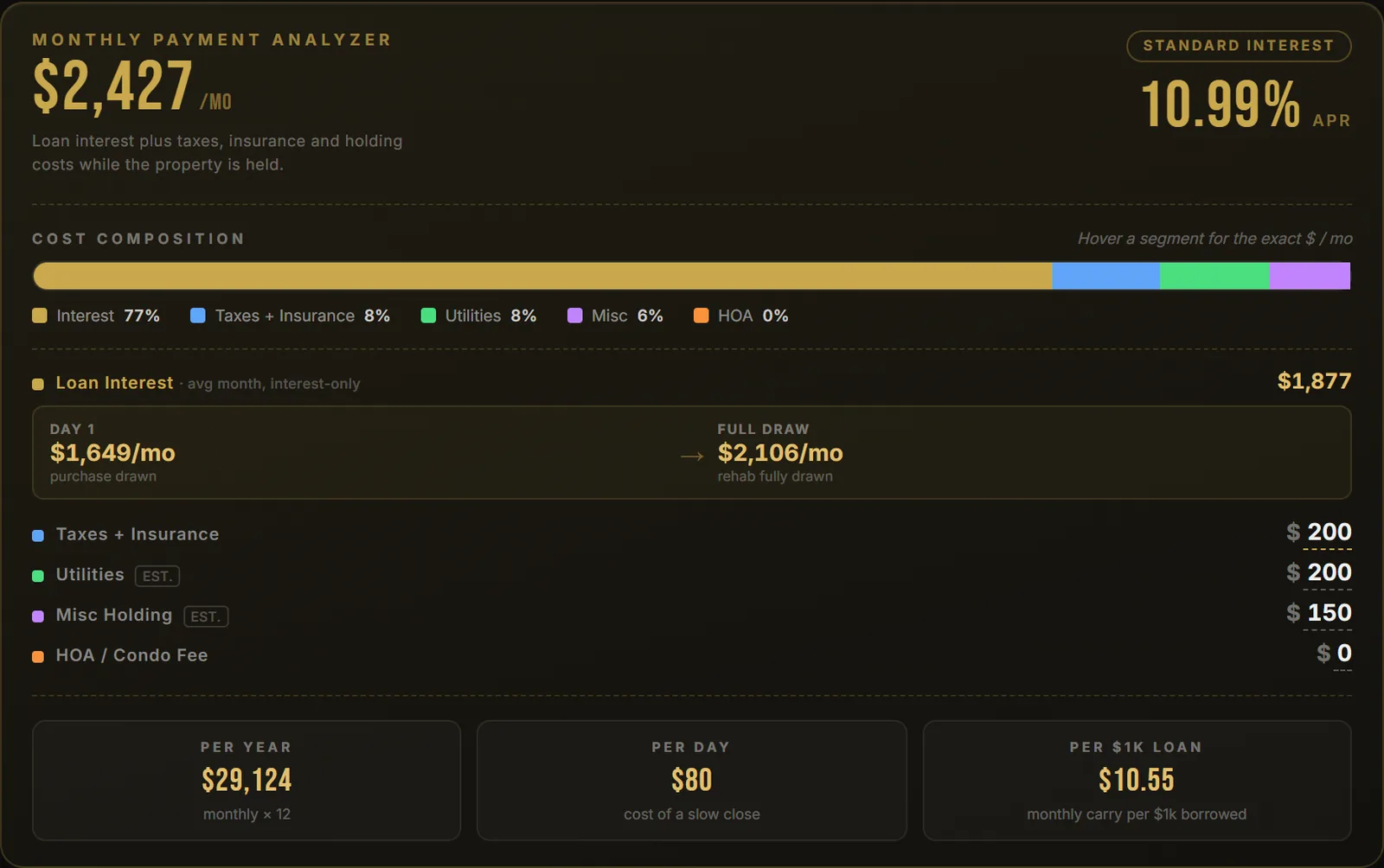
Here's what that looks like on our example deal. Both cards use the same loan, one on standard interest and one on Dutch. Each shows your day one payment and your payment once the rehab is fully drawn. Drag either slider and both cards move together, so you can see which one costs less at each stage of the rehab.
Those two cards are a stripped-down piece of our Deal Analyzer. The full version, with fees, hold costs, profit, and cash to close, is in the borrower portal.
Where I Fit In After Closing
Once the loan closes, you request draws directly from the lender. That's normal, and it's how every lender I work with does it. I don't disappear after closing, though. When the process is unclear, I'm the one calling the lender. I get you straight answers on what a draw request needs, and I push when a draw sits in someone's queue longer than it should. If your draw stalls, you won't be chasing a lender's draw department by yourself.
Frequently Asked Questions
What is a rehab holdback on a hard money loan?
Do I get my rehab money at closing?
How long does a construction draw take to fund?
Will the lender reimburse materials I bought but have not installed?
Why is the loan amount on my HUD bigger than what the lender wired?
Do I pay interest on the rehab holdback?
Want to see your purchase funding and holdback split before you apply anywhere?
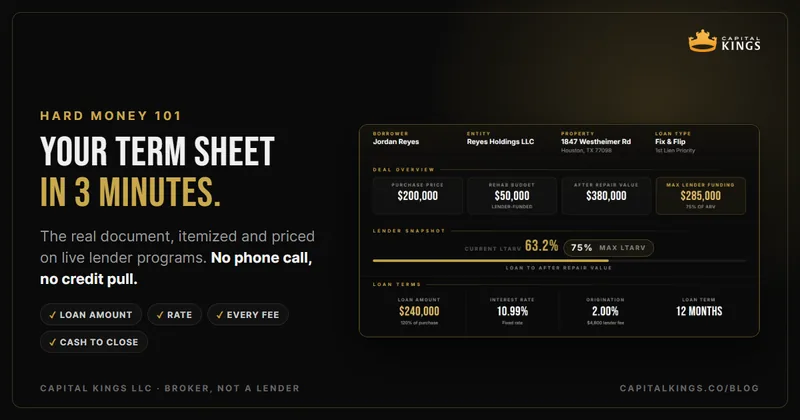
Run your deal through the instant term sheet. In about five minutes it breaks down how your loan is built, every fee, and your real cash to close, with no credit pull. The programs, rates and a worked example with the holdback split are on the fix and flip loan page.
Get my instant term sheet