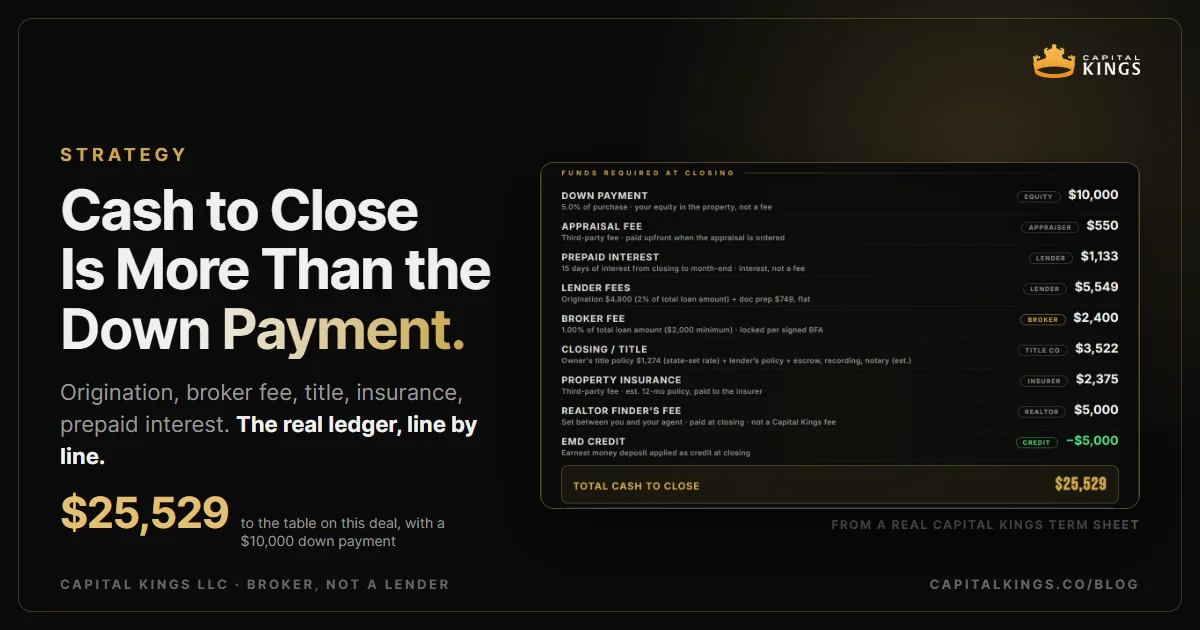
- Your down payment is the larger of two numbers: the lender's minimum percent of the purchase price, or whatever the max loan doesn't cover.
- Points, origination, and the broker fee all go into your cash to close, so know every one of them up front.
- Reserves are money you have to show the lender, but you don't hand it over. And your down payment isn't lost. It's equity in your deal. The fees are the cost of the loan.
Every investor knows they need a down payment. What blindsides people the first time, and sometimes the second and third time, is everything that stacks on top of it. When I see a deal fall apart at the closing table, it's almost never about the deal itself. It's about money nobody planned for. So let me walk you through how cash to close actually works on a fix and flip, with real numbers, the same way I explain it to every borrower I work with.
How Lenders Set Your Down Payment
Three numbers drive everything: your purchase price, your rehab budget, and your after repair value. Add the purchase price and the rehab budget together first, because that's your total investment in the property. Then look at the ARV, which is what the property will sell for once it's fixed up and ready to go.
The lender lends against that ARV. In larger metros like Houston, Dallas, Austin, Denver, Miami, or Tampa, that's typically up to seventy-five percent of the ARV. In more rural areas, lenders usually cap it closer to seventy percent. As long as your total investment fits under that number, the lender can cover the deal and let you bring the minimum down.
Max Loan = ARV × 75% (large metro) or 70% (rural)
Down Payment = Minimum % of the Purchase Price
This is the part most people get backwards. Your down payment is figured off the purchase price, not the total project, because the lender typically funds one hundred percent of the rehab budget. On a strong deal in Texas, I work with lenders who'll let an investor bring as little as five percent of the purchase price. Across the other thirty-six states I broker in, ten percent is closer to the standard for a first flip, and five percent down takes three or more completed flips. Ten percent is also common for quick closings and for borrowers with no credit history.
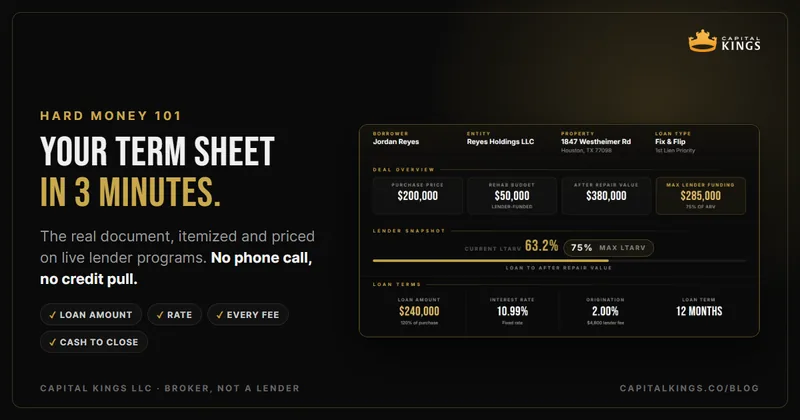
Let's put real numbers to it. Say you buy at $200,000 with a $50,000 rehab, so your total investment is $250,000. Your ARV comes in at $350,000. Seventy-five percent of that is $262,500. That's more than your total investment, so the deal works for the lender. If the max loan came in below your total investment, you'd bring whichever is bigger: the minimum percent, or the gap between the max loan and what you're putting into the deal. At ten percent down, you bring $20,000 on the purchase. At five percent in Texas, you bring $10,000. The lender funds the rehab. That down payment is the starting point for your cash to close, but it isn't the whole number.
What Stacks On Top of the Down Payment
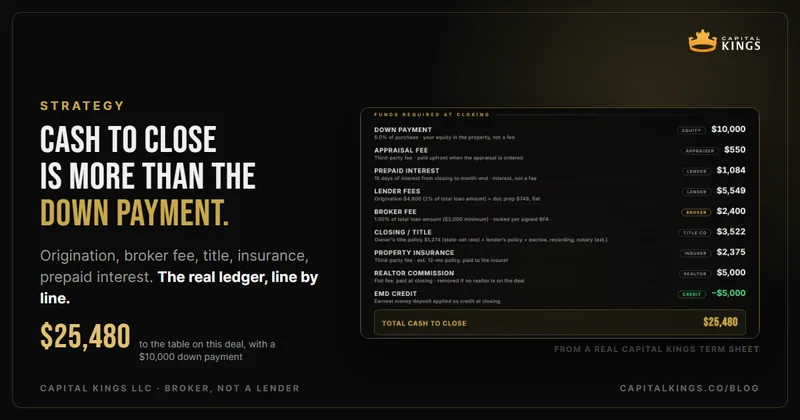
This is where the surprises live. On top of your down payment, your cash to close usually includes:
- Title fees, which run anywhere from $2,000 to $4,000 depending on the loan size. I tell borrowers to budget around $3,000 as an average.
- An agent finder's fee, if you're working with one. A lot of the agents I work with charge a flat finder's fee, often around $5,000. The amount is between you and your agent; I don't set it and don't get any of it. It gets added to the HUD (the closing settlement statement that lists every dollar in and out of the deal) and paid at closing.
- Appraisal and inspection fees, which you'll want to ask about before closing. Some of the lenders I work with don't charge anything for appraisal or inspection, which keeps your cash to close lower. Others do, so confirm it up front.
- Origination points, which I'll cover next, since those depend on you.
Points, Origination, and My Broker Fee
Origination isn't a fixed number. It moves with your experience level and how much leverage you want. The more money you put down, the lower your origination tends to be. The more you push your loan-to-cost (how much of the total project the lender is financing), the higher it goes. You should understand that tradeoff before you decide how much to bring down.
For new investors, origination typically lands somewhere between one percent and two and three-quarter percent of the loan. Experienced investors who know exactly what they want, and need less hand-holding, can often get into the zero to one and a half percent range, plus better rates. This is one place where experience pays you back in real dollars.
I'm going to be straight with you about my side too, because I think you should know exactly what you're paying for. My broker fee is typically around one percent, and it depends on the loan amount. On a larger loan, say six or seven hundred thousand dollars, I'll often bring that down to half a point. I'd rather earn a fair fee from a borrower who comes back to me ten times than squeeze one deal and never see them again.
Reserves: The Money You Need But Do Not Hand Over
This is the piece that catches new investors the most, because it doesn't show up as a line item you wire at closing. It's cash you have to prove you have. Lenders want to see reserves, and there are two kinds.
The first is rehab reserves. Lenders typically want to see somewhere between twenty and thirty-three percent of your rehab budget set aside. On a bigger rehab budget, that leans toward the lower end, around twenty to twenty-five percent. On a smaller rehab budget, it's closer to thirty-three percent. The second is interest reserves. Most lenders want to see roughly six months of interest payments available, so they know you can keep up with the loan even if the project runs long.
Run Your Own Cash to Close
Plug your deal into the calculator below. Move the sliders for purchase price, rehab budget, and ARV, and it updates a deal snapshot as you go. You'll see the estimated loan amount, down payment, origination and broker fees, title and legal, total cash to close, proof of funds required, and the monthly payment. It's the same tool I use on the phone with borrowers.
Your Down Payment Is Not Lost Money
A lot of investors treat the down payment like money that disappears. It doesn't. When you sell or refinance, you only pay the lender back the loan balance, so what you put down comes back to you. The fees are different. Points, title, insurance and the appraisal are the cost of getting the loan, so count them as an expense on the deal, not as equity.
The Bait and Switch Nobody Warns You About
Here's what a lot of lenders won't tell you. They don't always explain the risk that comes with your cash to close. A lender can run with the optimistic ARV a borrower submitted, send a term sheet built on that number, and let the borrower go through the whole process without ever sharing their own honest read on where the appraisal will land.
I've seen exactly how that plays out with lenders I don't work with. I had an investor whose cash to close jumped ten to fifteen thousand dollars the day before closing. They came to me, and because they were on a tight timeline, we were able to get them in with only five percent down and close in five days. They were thankful, because honestly they couldn't have afforded the higher number. If they'd been forced to put that much more cash in, they wouldn't have had enough left to start the rehab or make the monthly payments to keep the project moving. That's the real danger when your cash to close moves on you at the last second.
It's also why I run my own conservative analysis on every deal and show borrowers the full range of where their cash to close could land, including the less rosy end. Nobody I work with should get surprised at the closing table.
Get the Real Number Before You Send Earnest Money
What I wish every first-time investor had before going under contract is pretty simple: a good lender in their corner and a clear handle on their own numbers. Before you send your EMD (earnest money deposit, the good-faith money you put down when you go under contract), it's worth a call to walk through the whole process from start to finish. We can go over how closing works, how much money it really takes, and how every fee breaks down, including my broker fee down to the dollar.
I want the investors I work with to win, because when they make money, they come back. Honest numbers and honest evaluations are how you build relationships that last for years, and that's the only way I want to do this business.
Frequently Asked Questions
What is cash to close on a fix and flip?
How much down payment do you need for a hard money fix and flip loan?
What costs are included in cash to close?
Do hard money lenders require reserves?
Is the down payment on a flip lost money?
Want your real cash to close before you go under contract?
Send me the deal and I'll break down every number with you, down to the broker fee, so nothing surprises you at the table. If you'd rather see it on a real deal first, the fix and flip loan page walks through one Houston flip three ways, with cash to close for each.
Run my numbers