- Start with the term sheet you can actually get before you ever open a blank spreadsheet.
- Use the 70% rule to screen deals fast. Then run the real numbers, including your carrying costs and selling costs.
- When you decide go or pass, look at time as much as profit. If the margin is thin and the timeline is long, pass.
Most investors do one of two things when a deal lands in their inbox. They either overthink it, building a spreadsheet for three hours and missing the window, or they get excited and skip the math entirely. Here's the order I actually walk an investor through, and how to tell in a few minutes whether a deal is worth a closer look.
Start With the Term Sheet, Not a Spreadsheet
This is the first thing most people get backwards. Before you build anything, get a term sheet (the lender's written offer on your deal). When you submit an application on my site, you get an instant term sheet back. That one document tells you most of what you need to know up front.
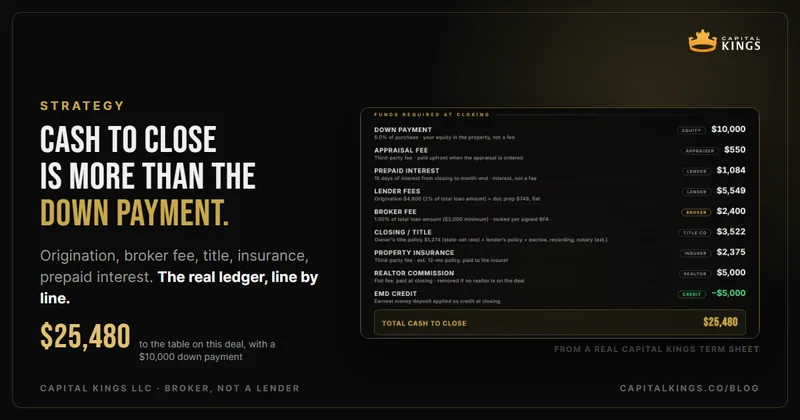
It shows you the lender's loan-to-value on this specific deal (how much they'll lend compared to what the property is worth), your estimated cash to close, and the proof of funds you'd need to get approved. The application runs your numbers at roughly five percent down on the purchase price. That's doable on a first flip in the major Texas metros. In the other states I broker in, a first flip starts at ten percent down, and five percent takes three or more completed flips (five or more in some states).
What you're really looking for is how much equity is in the deal. Say the lender goes up to 75 percent of the after repair value, and your deal is already sitting at 75 percent. You're maxed out. Every dollar past that comes out of your pocket, so your down payment and closing costs go up. But if the deal works at 70 percent with room up to 75, you have a cushion. That cushion is what saves you when the appraisal comes in low or the rehab runs ten or twenty percent over.
Step 1: Nail the ARV
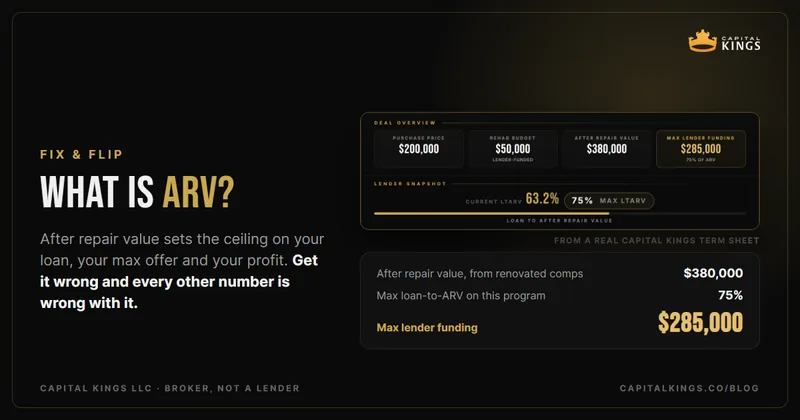
After repair value (what the home is worth once it's fully renovated) is the number everything else hangs on. Pull comparable sales (recently sold homes similar to yours, called comps) from the last 90 days, in the same neighborhood, with similar square footage, bed and bath count, and finish level. Use at least three.
Get this number wrong and every other number is wrong with it. If you want to go deeper, here's a full breakdown of how ARV actually works.
Step 2: Estimate the Rehab, Then Pad It
If you can't walk the property yet, use these 2026 ranges as a quick screen:
- Light cosmetic (paint, flooring, fixtures, cleanup): $25-$40 per sq ft
- Moderate value-add (kitchen, baths, plus cosmetic): $50-$75 per sq ft
- Full gut renovation (down to the studs): $90-$135+ per sq ft
If you're flipping in Texas, know that hot Sun Belt markets like Houston tend to run on the higher end of these ranges, because labor is in high demand. Lean conservative. Whatever number you land on, I build a 10 percent contingency (extra money set aside for surprises) into every budget I touch. Rehab costs run over far more often than they come in under, and that ten percent is the difference between a stressful project and a smooth one.
Step 3: Run the 70% Rule
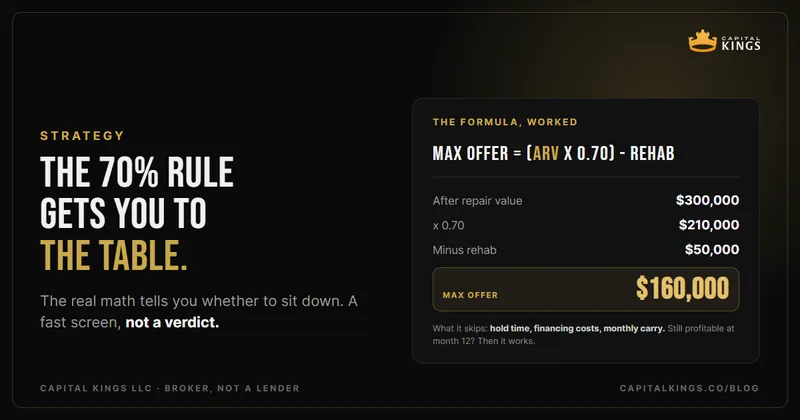
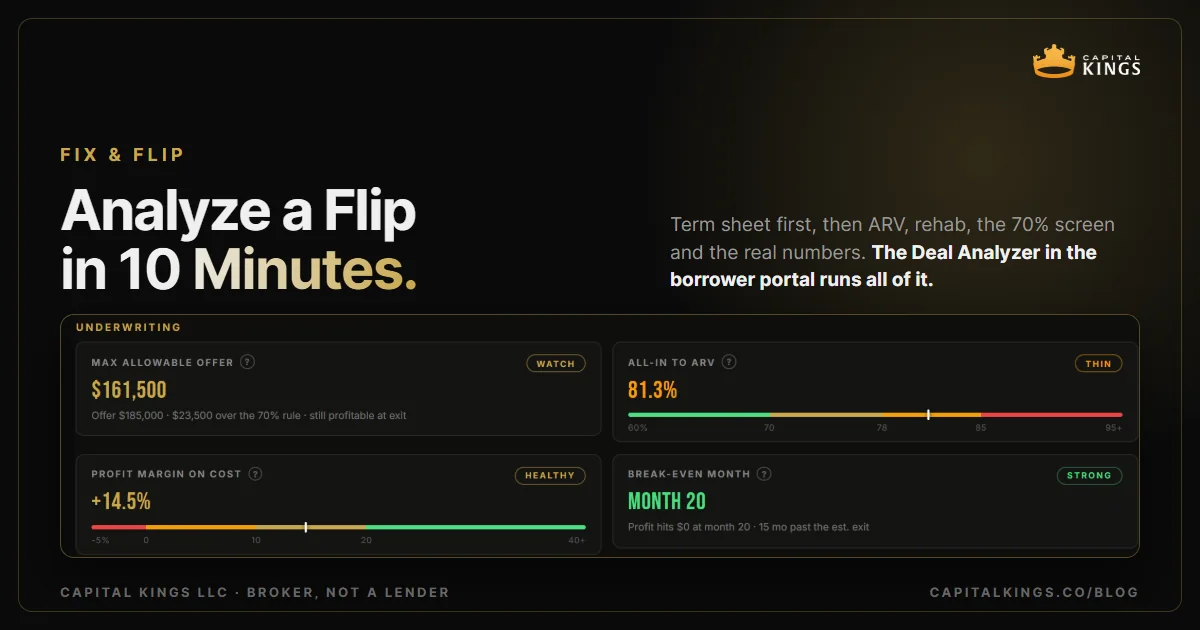
Say you've got an ARV of $350K and a $60K rehab. Max offer = ($350,000 x 0.70) - $60,000 = $185,000.
Treat that as your ceiling, not your opening offer. It's a screen to kill bad deals fast, not a profit number, and what it leaves out is in the 70% rule, explained.
Step 4: Run the Real Numbers (This Is Where People Slip)
If the deal passes the 70 percent screen, run the full picture:
- Purchase price
- Rehab costs (with your contingency)
- Financing costs (points plus interest for as long as you hold it, usually 6-9 months)
- Holding costs (taxes, insurance, and utilities for every month you own it)
- Selling costs (agent commissions and closing costs, roughly 7-9% of the sale price)
The Two Things New Investors Forget
Holding costs. This is the most common mistake I see when people run a deal. Investors lock in on purchase and rehab and gloss over what the property costs them every month. Every month that property sits, you're paying taxes, insurance, utilities, and loan interest. You need to know that number cold and know you can keep paying it, because a project that runs long quietly eats your profit.
Fronting the rehab. The lender pays your rehab budget back after each stage is done, so you or your contractor front the first chunk. I work with contractors who are fine with that, because they know the money is safe once the budget is closed in escrow and on title. Just don't go into a deal scraping to cover every draw.
Go or Pass: Time Matters as Much as Profit
A lot of guides tell you to chase a flat profit number, like 40 grand or nothing. I look at it differently. The question I really want answered is how long I can sit in this loan and still break even or make money.
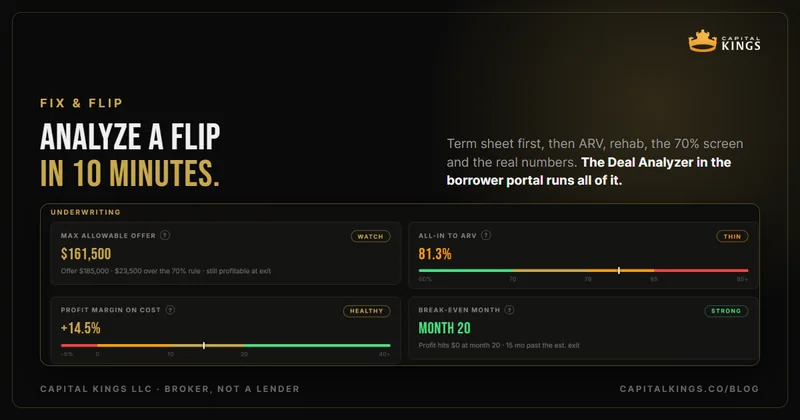
Still break even or better at month 12 is a good deal. Still profitable at month 18 is a phenomenal one, because that time is your protection when a project or a sale runs long. The 70% rule analyzer counts those months for you.
The Fast Way: My Deal Analyzer
Everything above is math you should understand. But you shouldn't have to do it by hand on every deal, and that's exactly why I built the Deal Analyzer. It lives inside my borrower portal, and the full tool is right here on this page too. You don't need a login or an application to use it. Just run your deal.
It tracks every number on the deal and lets you change any of them, like the interest rate, origination points, closing costs, title fees, or agent commission. Change one input and you'll see the whole deal update. It shows you:
- Your all-in to ARV ratio, which is everything you've put in, including every fee, divided by the after repair value
- What happens to your numbers if you go over budget
- Your estimated cash to close and the proof of funds you need to get approved
- DSCR rates, so you can size up a refinance and hold exit as well as a sale
- A month-by-month profit breakdown, so you can see exactly what you'd make selling at month 6 versus holding to month 12. It also shows how long you can carry the loan before you need to refinance
It's the same analyzer that runs in the borrower portal, with the same math and the same fees. The portal version also saves every scenario to your deal.
In the portal, Capital Kings Intelligence sits right below it, with property details, a map and quick comps.
Frequently Asked Questions
How do you analyze a fix and flip deal quickly?
What is the 70 percent rule in house flipping?
How much does a rehab cost per square foot in 2026?
What do new investors get wrong when analyzing a flip?
How do I know if a flip is a good deal?
Want to Run a Deal Right Now?
Submit one application and you'll get an instant term sheet, plus full access to the deal analyzer with month-by-month profit, all-in to ARV, exit strategies, and property intelligence. You don't have to get on a sales call. The financing side of that math, with today's rates and a worked Houston example, is on the fix and flip loan page.
Get Pre-Qualified →