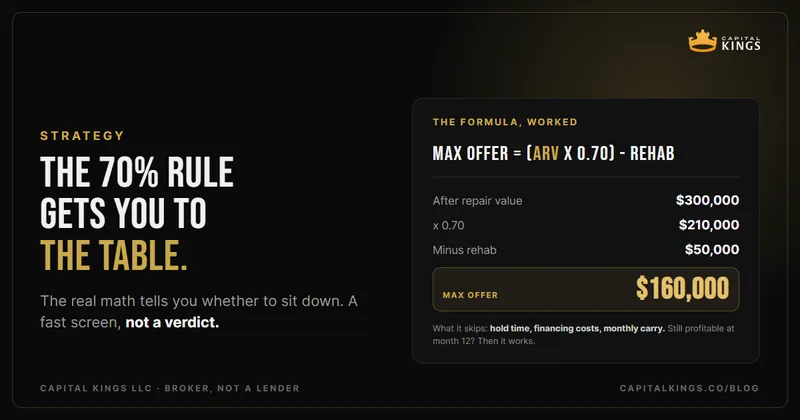
- ARV is what the property will be worth after the work is done, based on recent sales of similar renovated homes.
- Lenders size your loan off the ARV, so if that number's inflated, your real loan and your profit end up smaller than you planned.
- Most wholesaler ARVs run high, because a higher number helps them sell you the deal. Always run your own comps.
ARV stands for after repair value. It's what a property should be worth once all your planned renovations are done. On a fix and flip, it's the most important number you'll work with, because everything else is built on top of it. Your loan amount, your maximum offer and your profit all come from the ARV. If you get this number wrong, every other number is wrong with it.
What ARV Means
The easiest way to think about ARV is to ask yourself one question. If I finished this renovation today, to the standard I'm planning, what would a buyer pay for it? That answer is your ARV. It's what the finished house would be worth in today's market. What it's worth right now in its tired condition is a different number, and so is whatever you're hoping it sells for.
How to Pull Comps the Right Way
ARV is built from comparable sales, or comps. These are recently sold homes that are similar to what yours will be once it's renovated. The closer your comps match your house, the more you can trust your ARV. Here's what makes a good comp:
- Recently sold, ideally within the last 90 days, so the data reflects today's market
- Close by, within about half a mile and in the same neighborhood
- Similar in square footage, bed and bath count, and finish level
- Renovated, finished to the standard you're planning, not another fixer-upper
- At least three of them, so you're averaging real data instead of leaning on one sale
This is where people get into trouble. A home that sold one neighborhood over, on a nicer street, or in a better school zone isn't your comp, even if it looks similar on paper. Pulling comps that are a little too nice is the fastest way to talk yourself into an ARV the market won't actually pay.
How Lenders Use ARV to Set Your Loan
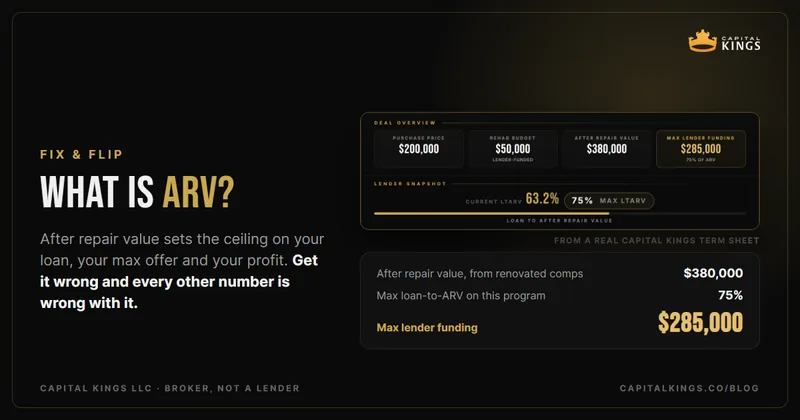
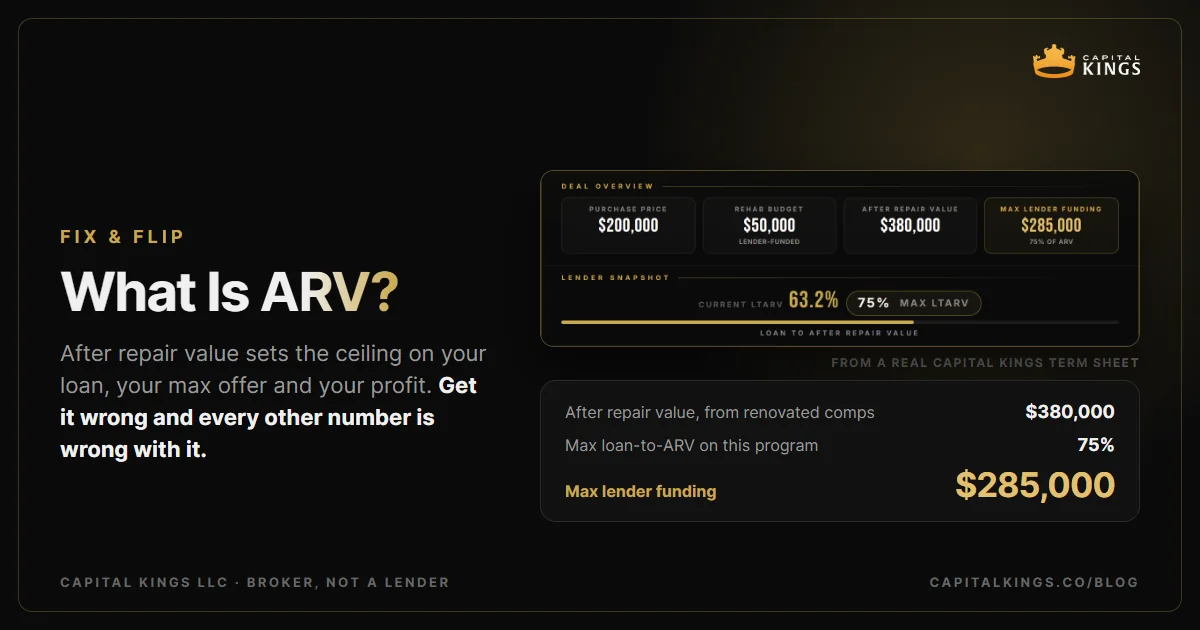
Hard money lenders cap your loan at a percentage of ARV. On a fix and flip, that's often up to about 75 percent. Most lenders land somewhere in the 65-75 percent range, depending on the deal and your experience.
Say the ARV is $400,000 and the lender goes up to 75 percent. Your maximum loan is $300,000, and that has to cover both your purchase and your rehab. If you're buying for $200,000 and your rehab is $80,000, your total project cost is $280,000. That sits comfortably under the $300,000 cap, so you've got a cushion. But if your total cost crept up to $310,000, you'd be over the cap, and every dollar past it comes out of your pocket. That's exactly why your ARV has to be honest.
ARV vs. As-Is Value
It's easy to mix these two up. As-is value is what the property's worth today, in the rough shape it's in now. ARV is what it'll be worth after the work is done. Some lenders quote their leverage against as-is value and others against ARV, and that difference matters.
A 90 percent loan against as-is value can actually end up being a smaller loan than a 75 percent loan against ARV, depending on how far apart the two values are. So don't compare the percentages by themselves. Run the actual dollar amounts and see which one puts more money into the deal.
The Mistake That Wrecks Deals: An Inflated ARV
The biggest ARV mistake I see comes from brand-new investors who don't have a good agent or a good lender in their corner. They get a deal from a wholesaler, see the ARV on the marketing sheet, and build their whole deal off that number. The problem? You can't just trust a wholesaler's ARV.
A lot of the wholesalers I work with send good deals with honest numbers, and I like connecting investors with the ones I know do that. But across the market, plenty of wholesaler ARVs run high, because a higher ARV makes the property easier to sell at a higher price. That's just how the business works, so even with a wholesaler you trust, check the ARV against the comps yourself instead of taking it at face value.
This matters because the lender doesn't use your ARV either. They order an appraisal and go with the appraiser's number. If you built your whole deal around a $400,000 ARV and the appraisal comes back at $370,000, your loan just shrank. Now you'll have to cover the difference in cash you may not have planned for.
That's exactly why I run a CMA report (a comparative market analysis, basically my own comp check) on every single deal that comes through my pipeline. I'm not an appraiser. But back when I worked for a direct lender, I saw the appraisal process all the way through on a lot of files, so I pull my comps the way I think an appraiser actually will when they walk that property. Then I send those comps to the borrower. If my number comes in under what they were expecting, I don't just deliver bad news. I send two or three term sheets so they can see their cash to close if the appraisal hits their ARV, if it hits my more conservative ARV, and if it comes in low. That way nobody gets caught off guard at the closing table.
Whether or not you have a broker running comps for you, the lesson is the same. Lean conservative on your ARV and build in a buffer. If your deal only works at the very top of your ARV range, it doesn't really work. Run the numbers at the low end before you ever make the offer.
Frequently Asked Questions
What does ARV mean in real estate?
How do you calculate ARV?
How do lenders use ARV to set your loan amount?
What is the difference between ARV and as-is value?
What happens if the appraisal comes in below my ARV?
Want a Second Set of Eyes on Your ARV?
Before you make an offer, send me the deal. I'll help you double-check your ARV and your comps against what a lender's appraiser is actually going to see, so you're not caught short at closing. To see how the ARV cap changes your loan amount on a real deal, run the example on the fix and flip loan page.
Get Pre-Qualified →