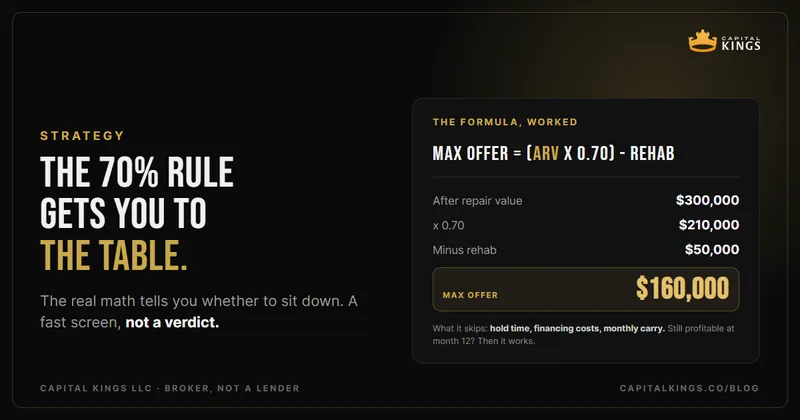
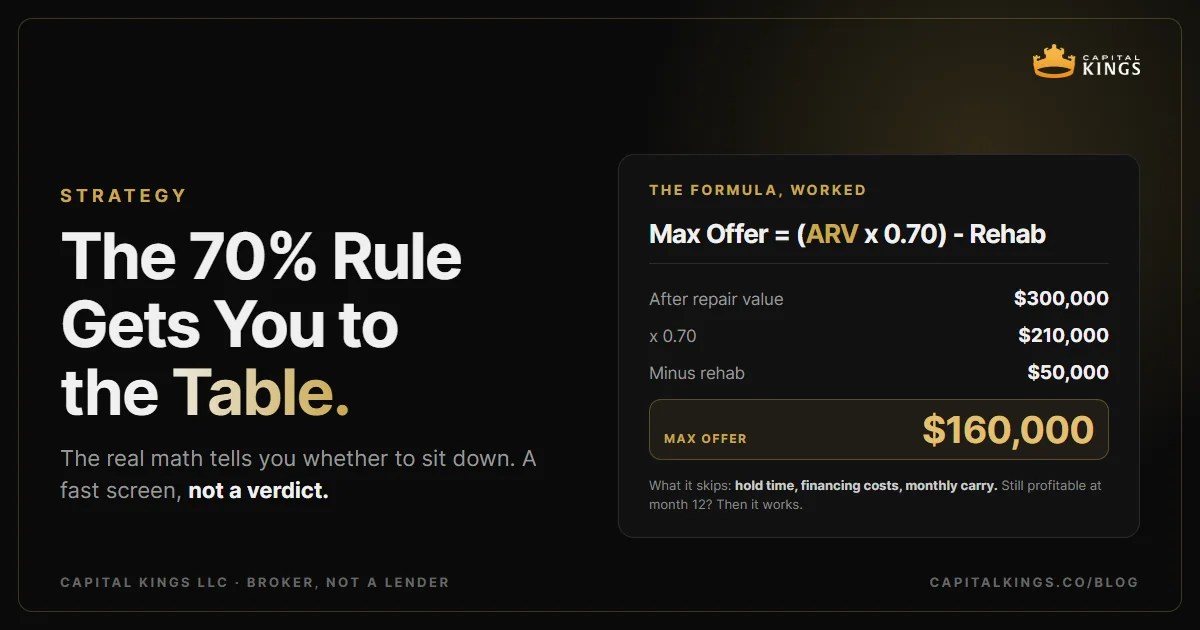
- The 70% rule says your max offer is roughly 70% of ARV minus rehab. Use it to screen deals fast, then run the full numbers before you decide.
- It leaves out carrying costs, financing, and your timeline, so don't decide on it alone.
- Going above 70% can make sense on the right property. The rule is a baseline, and you can go past it when the full math works.
The 70% rule is probably the most quoted formula in real estate investing. Ask any flipper how they screen deals and you'll hear about it in the first thirty seconds. It's useful, and it's also widely misunderstood. The way I see it, the 70% rule is a fast way to throw out bad deals. It isn't how you decide to buy one.
The Formula
The idea is simple. You take 70 percent of the after repair value (what the home is worth once it's fully renovated), subtract what the rehab will cost, and that's the most you should offer. The other 30 percent is meant to be rough room for your financing, your holding costs, your selling costs, and your profit. Notice the word rough. That 30 percent is a cushion, and a lot of people treat it like a precise budget. That's exactly where they get into trouble.
What the 70% Rule Is For
The real job of the 70% rule is speed. When you're looking at a lot of deals, you can't build a full model on every one. The 70% rule lets you run a property in under a minute and decide whether it's even worth a deeper look. It also anchors your offer to what the home will be worth fixed up, instead of what the seller thinks their tired house is worth today.
Used that way, it keeps you from overpaying.
What It Leaves Out
Here's the catch. The 70% rule assumes your costs and your timeline behave. The second those shift, the rule starts misleading you, because it never looked at them in the first place. The biggest things it ignores:
- How long you hold the loan. The rule treats a fast flip and a project that drags on for a year the same way, and they're nothing alike. Every extra month means more interest and more carry, and that eats the 30 percent cushion alive.
- Your real financing costs. The points, rate, and fees on your actual loan aren't baked into a flat 70. Two deals can screen the same and cost very different amounts to finance.
- Your monthly carry and cash to close. Taxes, insurance, utilities, and the cash you need up front never show up in the formula, but they absolutely show up in your bank account.
Why I Don't Decide on the 70% Rule
When an investor asks me whether to pull the trigger, I run the full numbers and ask a better question. How long can you sit in this loan and still come out ahead?
That time cushion is the real test. If the deal is still break even or profitable at month twelve, that's a good deal. If it's still profitable at month eighteen, that's a phenomenal one, because it means you could get stuck in a high-interest hard money loan for a year and a half and still win. The 70% rule won't ever tell you that. The full math will, and that's why I built the deal analyzer below, so you don't have to do it by hand.
When Going Over 70 Percent Still Makes Sense
Treat 70 percent as a baseline, not a hard ceiling. I'm fine going over it when the numbers back it up. I've seen 80 percent deals that were incredible because the rest of the math worked out. A few things can let you push past 70:
- How fast the market moves. A neighborhood where homes sell in thirty to sixty days carries a lot less risk than one where they sit for five or six months. Less time on the market means less holding cost, so a faster market can support a higher number.
- How much rehab it needs. An 80 percent deal on a property already in good shape can beat a 70 percent deal that needs a full gut. Less rehab means less time, fewer holding costs, and less that can go wrong before you list.
- The size of the loan. On a bigger loan, the dollars in your cushion are bigger even at the same percentage, and that can leave plenty of room for profit.
It always comes back to the same test. With every holding cost factored in, are you still profitable at month twelve? If the answer is yes, the deal works, whether it screened at 68 percent or 80. It's a numbers game, and no single number gets to decide it.
Where the Rule Fits in Your Process
Run the 70% rule first to kill the obvious losers. On anything that clears it, swap the rough 30 percent for real numbers: comps you trust, a rehab budget you'd stand behind, and your actual loan. The analyzer below does that part.
Run Your Deal Through the Analyzer
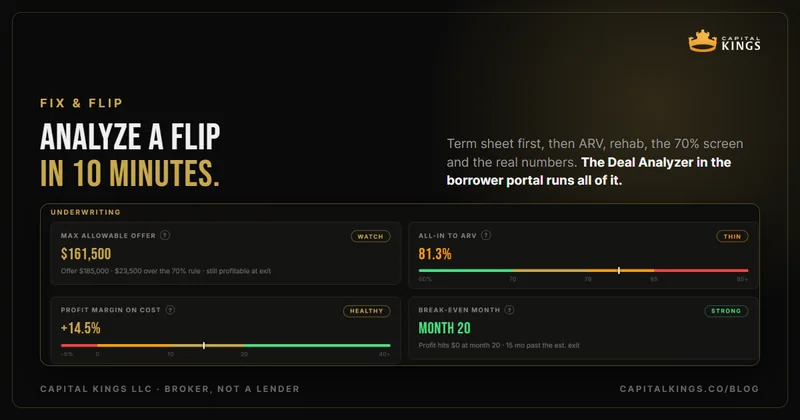
This is the tool I mentioned. The top half runs the 70% screen in a second. The bottom half does the part almost no other calculator online bothers with. It tells you how many months you could hold this exact deal before your profit hits zero. Change any number to match your own deal.
Frequently Asked Questions
What is the 70% rule in real estate?
How do you calculate the 70% rule?
Is the 70% rule still accurate in 2026?
What does the 70% rule leave out?
Should you ever pay more than the 70% rule says?
Found a Deal That Pencils?
Run it through the analyzer above, then bring me the ones that clear. One application gets you real lender quotes and actual financing costs, so you can swap these estimates for the numbers you'll actually close on. If you want the lender side of the math before you offer, the fix and flip loan page shows what 5%, 12.5% and 15% down each cost on the same house.
Get Pre-Qualified →