"100% financing" is real, and I close it. It's just not what the ads make it sound like, and most of the investors who call me asking for it end up choosing something else once they see the numbers side by side. Here's the plain version.
Quick answer: 100% financing pays for 100% of the purchase price and 100% of the rehab, as long as the loan stays under 70% of the after repair value (what the house is worth once the work is done). It runs 11.75% with 3 points and needs a 650 credit score. First-time investors qualify, and it's available in the major Texas metros. On a strong deal the closing costs can sometimes roll into the loan too, but on most 100% deals you still pay them at the table.
What 100% Financing Actually Is
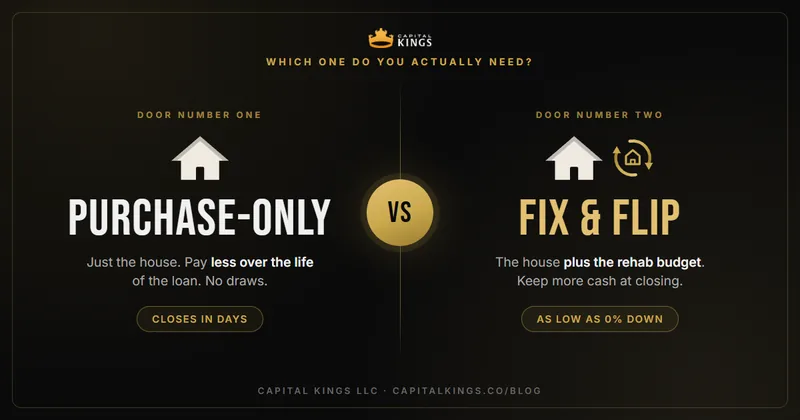
On a normal fix and flip loan, you put money down on the purchase and the lender funds the rehab through draws (payments released as the work gets done). On the 100% financing program, the lender funds the purchase too. You don't make a down payment on the purchase, and you don't put your own cash into the rehab.
The whole program comes down to one number: the loan can't be more than 70% of ARV. Every other fix and flip program I broker goes to 75%. That five point difference is what you give up for the extra leverage, and it decides whether a deal fits before anything else does.
The other cost is the rate. The program is 11.75% with 3 points of origination, while my 5% down program starts at 9.99% with 2 points. The lender is taking on a borrower with none of their own money in the deal, and they charge for that.
The Deal Still Has to Fit Under 70%
Let's use round numbers. Say you're buying a house in Houston for $160,000 with a $45,000 rehab and a $280,000 ARV. Your total cost is $205,000.
So "no money down" on this deal really means $9,000 down before you count a single fee. Push the ARV to $300,000 and the cap becomes $210,000, so the gap disappears. Whether a deal is really zero down comes down to the ARV.
What Still Wires at Closing
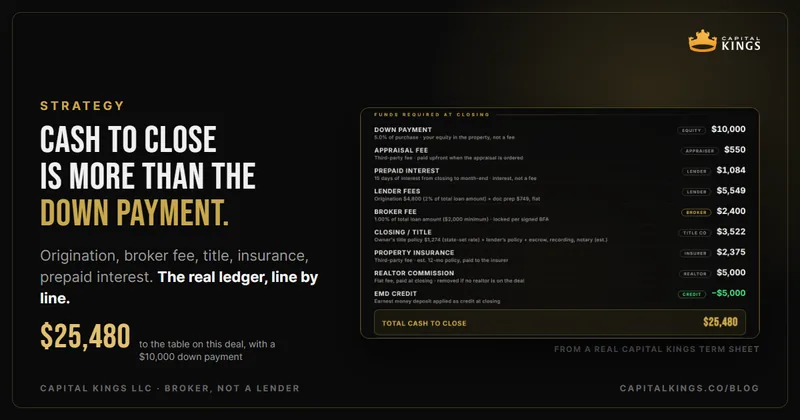
Leverage changes your down payment. It doesn't change your closing costs, and on 100% financing a few of them actually go up, because the loan is bigger and so are the points.
- Origination: 3 points on the loan amount. On a $196,000 loan that's $5,880.
- Broker fee: 1% of the loan, $2,000 minimum.
- Texas title: the owner's policy, the lender's policy and escrow, about $3,300 on a deal this size.
- Builder's risk insurance: in place before closing, about $1,950 on a house like this (0.95% of the purchase plus the rehab for a year).
- Appraisal and document prep: about $550 and $749.
- Prepaid interest: from the closing date to the end of the month, at the loan's interest rate, on the full loan.
Can closing costs roll into the loan? Sometimes. The lender I use most for 100% financing advertises that it can finance the purchase, the repairs and the closing costs. That only works when there's enough room under the ARV cap for all three, and most deals don't have it. So on most 100% deals, the borrower still pays closing costs at the table.
Then the lender checks your reserves. The proof of funds on my term sheets is cash to close, plus six months of interest on the full loan, plus a share of the rehab budget. Not all of that leaves your account, but it has to be sitting there.
100% Financing vs 5% Down on the Same Deal
Same house, same rehab, same ARV. The only thing that changes is the program.
| Line | 100% financing | 5% down |
|---|---|---|
| Max loan to ARV | 70% ($196,000 cap) | 75% ($210,000 cap) |
| Loan amount | $196,000 | $197,000 (95% of purchase plus all rehab) |
| Down payment or gap | $9,000 gap | $8,000 down |
| Rate | 11.75% | from 9.99% |
| Origination | 3 points, $5,880 | 2 points, $3,940 |
| Broker fee | $2,000 | $2,000 |
| Title, insurance, appraisal, doc prep | about $6,550 | about $6,550 |
| Prepaid interest, 15 days | about $950 | about $810 |
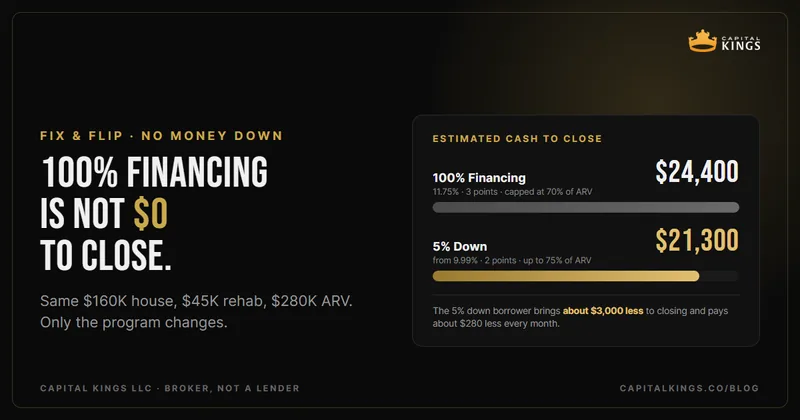
| Estimated cash to close | about $24,400 | about $21,300 |
| Monthly interest, full loan | about $1,919 | about $1,640 |
On this deal, the borrower who picked "no money down" brings about $3,000 more to closing than the borrower who put 5% down, and pays about $280 more every month while holding the house. These are estimates, and your term sheet will show the exact figures, but most deals I see go the same way. The extra point of origination and the lower ARV cap cost more than the 5% down payment saves.
Try pushing the ARV up. At some point the 70% cap stops leaving a gap, and if there's enough room left over for the closing costs too, that's the kind of deal where rolling them into the loan becomes a real conversation.
The 5% Down Option I Steer People To
It lends up to 75% of ARV at 2 points, with a rate from 9.99% that gets better as your credit and experience improve. You need at least a 590 credit score, and no experience is required. Most first-time flippers in Houston, Dallas, Austin and San Antonio who run a term sheet with me end up on this program, because it usually leaves them the most cash to work with.
People are often surprised that it takes a lower credit score than the 100% program. Look at it from the lender's side, though. A lender with 5% of your money in the deal is more comfortable than one with none of it.
Where These Programs Work
Both the 0% and 5% down programs are only available in the major metros: Houston, Dallas, Austin and San Antonio, generally within 30 to 40 miles of the core. A house in a rural county goes to different lenders on different terms, usually with more down and a lower ARV cap. If you're not sure whether your address counts, the term sheet will tell you in under two minutes. The Texas program, with a real Houston Heights deal that fit under 70% priced through the term sheet, is on the 100% financing in Texas page.
When 100% Financing Is the Right Call
I don't love this program, but I'll close it all day for the right investor. It's the right call when:
- You've got two or three deals under contract and want to spread your cash across all of them instead of parking it in one.
- The ARV is strong enough that the 70% cap doesn't leave a gap, so the only extra cost is the rate and points.
- You've run the monthly holding cost at 11.75% against how long it'll take to sell, and the profit still works.
It's the wrong call if the reason you want it is that you can't cover closing costs and reserves. Leverage won't fix a cash problem. It just moves the problem to the closing table and adds interest on top.
Two Things I Will Not Tell You
I won't promise your cash to close will be zero. A few lenders will roll closing costs into the loan on a really strong deal, but most 100% deals aren't that strong, so plan on bringing closing costs and showing reserves. If yours has the room, I'll ask for it.
I won't sell you cross-collateralization. Putting up another property you own instead of cash does exist in this industry, but I've never closed one, so I don't advertise it. When someone asks, the honest answer is the 5% down program or a smaller first deal.
See Your Real Number
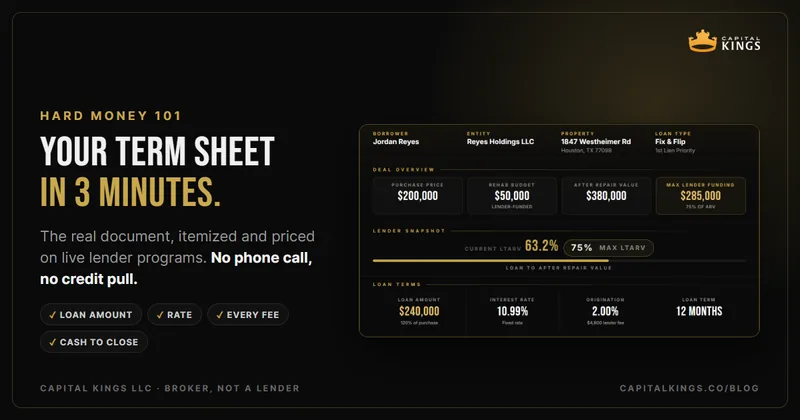
The calculator above is an estimate. The instant term sheet on the application prices your actual deal both ways before anyone calls you. If it fits under the cap and you still want the leverage, I'll place it. If 5% down comes out ahead, the sheet will show you that too. And if you want to know what happens once that sheet is in your hands, the whole road after you apply is laid out step by step.
Frequently Asked Questions
Is 100% financing on a fix and flip real?
Does 100% financing mean $0 cash to close?
What credit score do I need for a no money down hard money loan?
Is the 5% down option cheaper than 100% financing?
Where is 100% financing available?
Can I use another property as collateral instead of cash?
Want to see both programs on your deal?
The 100% financing and 5% down programs are priced side by side on the fix and flip loan page, on the same house, so you can see which one actually costs you less at closing. Or run your own deal through the instant term sheet and compare them in about three minutes.
Compare them on my deal