- For most investors, a heavy rehab is a lot more doable than a ground-up build.
- Experience won't keep you out of ground-up. First-time builders can get up to 85% of total project cost as long as the general contractor on the job has 5 or more completed builds, and every build you finish gets you better terms and a lower rate.
- Ground-up usually means more cash to close and more months of paying interest before any money comes back to you.
Almost every investor who asks me this expects a complicated answer. Most of the time, it isn't. When someone's deciding between a heavy rehab on a fix and flip and a brand-new ground-up build, I point them toward the heavy rehab far more often than not. Ground-up isn't bad, and you don't need a finished build behind you to get funded on one. The deck is just stacked in favor of rehab for most investors, and a lot of that comes down to how much cash a build ties up. Here's why, and when ground-up actually does make sense.
Why I Usually Point Investors Toward a Heavy Rehab
A heavy rehab, sometimes called a gut renovation, means you buy an existing house and rebuild it. You keep the foundation, the framing, usually the roof, and redo everything else. Here's why I lean this way for most investors:
- Permitting is simpler. A renovation permit is almost always faster and cheaper to pull than a full new construction permit.
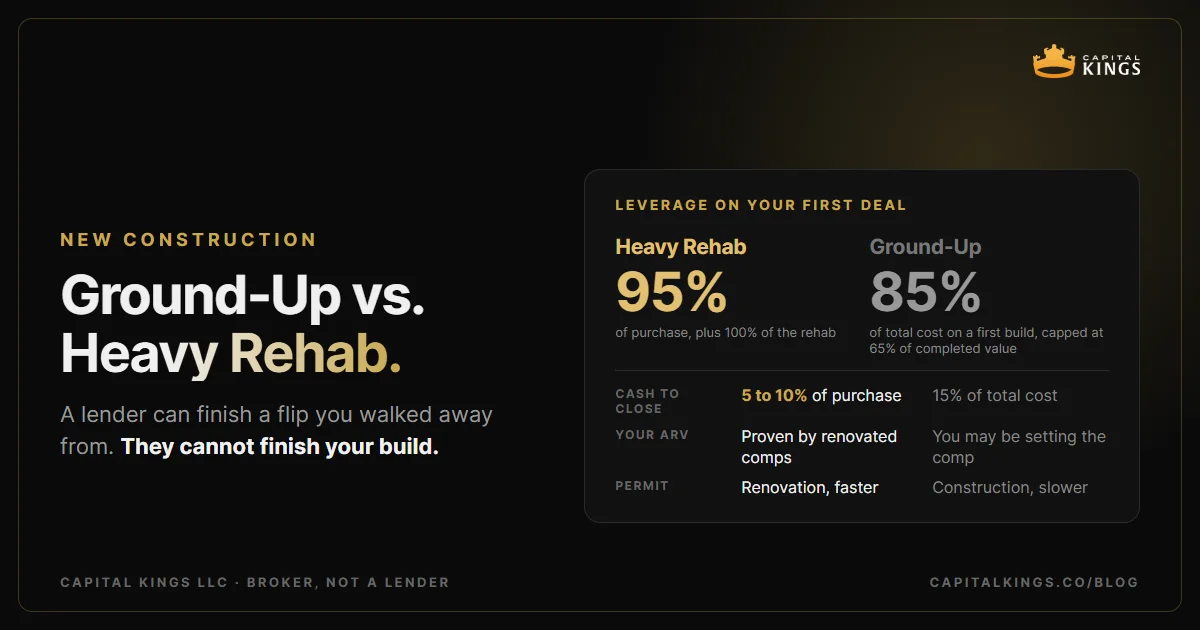
- Your ARV is already proven. Fix and flips usually sit in older, established neighborhoods full of renovated comps (recent sales of similar fixed-up homes). The appraiser has real sales to work from, so your after repair value (what the home is worth once the work is done) is easier to support. With new construction, depending on the area, you might end up setting the comp yourself. In neighborhoods with plenty of new builds, that's fine, because buyers there have already shown what they'll pay. But in a lot of areas you're the one proving what a brand-new house sells for, and that's a riskier bet.
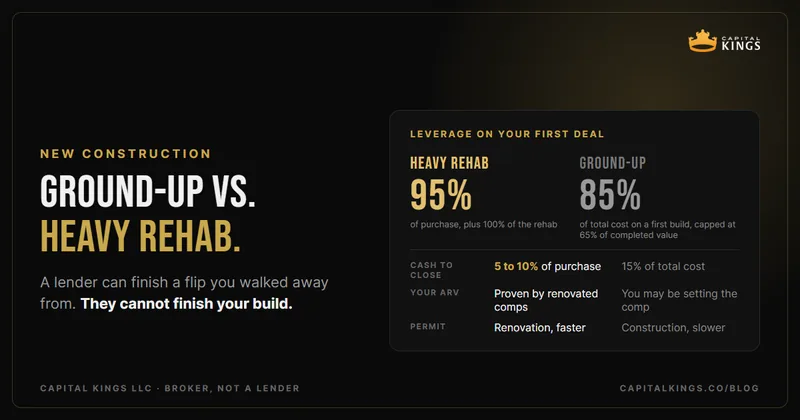
- No experience required. You can do a heavy rehab as a first-time investor. I've had investors run ninety to a hundred thousand dollars of rehab on their very first flip. That's a big project for a first deal, but it's doable, and lenders will fund it with no track record. In the major Texas metros that's 5% down, the same leverage they'd give you on your tenth flip. In the other states I broker in, a first flip starts at 10% down and completed flips unlock less. On ground-up, your first build gets less.
Experience Changes Your Terms, Not Whether You Qualify
A lot of people think you need finished builds before anyone will give you a construction loan. You don't, as long as the general contractor building the house has 5 or more completed builds. I researched it and made a video on the terms new investors actually get, and you can watch it on the new construction loan page. On a first build, lenders go up to 85% of the total project cost and up to 65% of what the house is worth when it's done. You bring the other 15% of the project cost, and it goes toward the lot at closing.
I should've made one thing clearer in that video. On your first build, the lender wants a general contractor with 5 or more completed builds signed on to the job. One lender put it in writing for me. They'll do first-time builders, but they want to see a licensed GC. So if you were planning to build it yourself through your own company, bring in a GC with 5 or more completed builds for this one. Once you've finished a build, you can run the next one yourself.
So experience won't keep you out. What it changes is your terms. A first build gets the least leverage and the highest rate. Finish one and the same project goes to 70% of the finished value at a lower rate, or to 9.50% with a financed interest reserve built into the loan (680+ credit), and it gets better again after five. Every tier is in the new construction rate table.
There's a real reason a first build gets less, and it comes down to what the lender is betting on. On a fix and flip, if you default, the lender can take the house back, finish the rehab, and sell it themselves. They already underwrote the deal, so they know the numbers and what it sells for fixed up. On a ground-up loan, they're betting on you. If they hand you a three hundred thousand dollar construction loan and you stall out halfway, they're stuck with a half-built project that nobody's lining up to buy. So on a first build they keep more of your money in the deal, and they'll want a real budget, a general contractor with 5 or more completed builds on the job, and money in the bank before they fund it.
The Cash-to-Close Difference
Because of that risk, the leverage (how much of the deal the lender pays for) looks very different on each side. On the fix and flip side, I work with programs right here in Texas where even newer investors bring as little as five to ten percent of the purchase price. The lender funds one hundred percent of the rehab budget and goes up to about seventy five percent of the ARV. That keeps your cash to close low, so your money can stretch across more deals.
On ground-up, those numbers tighten. There are fewer new construction projects than renovations, so values are harder to prove, and the lender is taking more risk on you. Expect to bring more cash to close and to get less leverage against the total budget. You could be the same investor in the same market and still need a very different amount of money out of your pocket on day one.
The build budget gets funded in draws on both loans, so that's not where the gap comes from. It's the property. The rehab loan covers most of the purchase at closing. On a first build the loan tops out at 85% of the whole project, the build eats most of that, and a big piece of the lot lands on you. That's the 15% you bring. After a finished build it stays at 15% on the lower-fee structure, or drops to about 10% in cash with a financed interest reserve, which costs more in points and fees.
How the Loan Pays Out: Draws and Carry
The way the money gets paid out is different too, and it changes your monthly payment. On a ground-up loan, you close on the lot first. The lot is usually just a fraction of the full construction budget, so your loan and your monthly payment both start low. From there, you finish a phase, the lender inspects it, and they release a draw (construction money paid out in stages as you finish work). Your balance and your payment climb as the build goes up.
That means more draws than a typical rehab, and more draws can mean more fees. Always ask if your lender charges a draw fee and how much, because it adds up over a long build. You'll also need to manage your contractors more tightly than you would on a renovation. You're running a full project from the dirt up, and every month the build drags, you're paying interest.
Ground-up is standard interest, basically always, so you only pay on what's been drawn. Dutch interest on a build this long would be brutal, and here's why.
What This Looks Like in Houston Right Now
Local conditions matter, and right now Houston is leaning toward buyers. According to Houston-area MLS data, days on market hit sixty-nine in early 2026, the highest in over a decade. Inventory has climbed back to a more balanced level near five months. New construction has been stacking up in inner-loop areas like the Heights, Midtown, and Montrose, and I've seen new construction projects sit on the market recently myself.
When houses are selling slower and you're the one setting the comp, that's exactly when a ground-up bet gets riskier. A heavy rehab in an established neighborhood with proven comps gives you a safer way out. I'm not saying don't build. Just know your part of town inside and out before you commit to setting the price.
So Which Should You Do?
If you're newer, the cash usually makes the decision for you. You can get a first build funded, but between the bigger check at closing, the tighter leverage, and the longer stretch of paying interest, a heavy rehab is the easier place to start for most people. Doing a rehab first and moving into ground-up later is still the path I see work most often, and once you've finished a build, the next one gets better terms.
If you've already got builds behind you, or the cash for your first one, and a lot in a market where buyers really are paying more for new homes, ground-up can absolutely make sense. Just run your own numbers and look hard at your area before you pick. In the end, go with the one you can actually pull off with the money and the team you have, in the market you're in.
Frequently Asked Questions
Is ground-up construction or heavy rehab easier to finance?
Do you need experience to get a new construction loan?
Why is cash to close higher on new construction?
How do draws work on a new construction loan?
Can you get Dutch interest on a new construction loan?
Not Sure Which Way Your Deal Leans?
Send me the numbers and the address. I'll tell you straight whether a heavy rehab or a ground-up build makes more sense for your experience level and your market, and which lenders in my network will actually fund it.
Get Pre-Qualified →