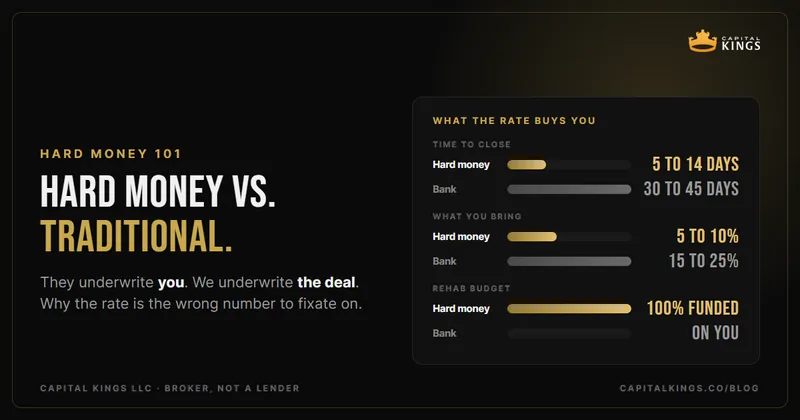
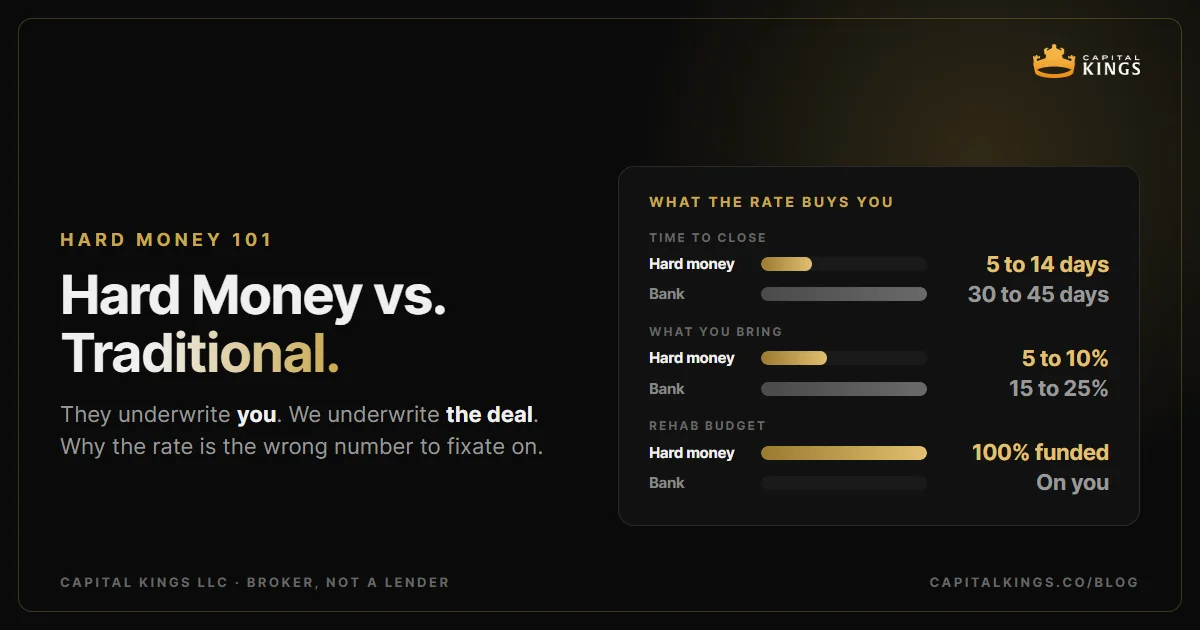
- Traditional lenders underwrite you: your income, credit, and debt ratios. Hard money underwrites the deal, meaning the property and the exit.
- On a short-term flip, the interest rate isn't the number that matters most. Speed, and knowing your loan will actually close, usually matter more.
- Hard money is built for short holds. If you plan to hold long term, it's the wrong tool.
When a first-time investor sees a hard money rate, the reaction is almost always the same. "Ten, eleven, twelve percent? My buddy just got a mortgage at seven." I get it. But that's comparing two tools that aren't even trying to do the same job. Once I walk people through what they're actually getting, the rate stops being the thing they fixate on.
I only broker investor loans, not bank mortgages, but I'm not here to talk you out of a bank loan when it fits you better. I'm here to show you the real difference, because picking the wrong one can cost you a deal or trap your cash in a single house for two years. Here's how I break it down for every investor who asks.
They Underwrite You. We Underwrite the Deal.
A traditional lender, like a bank or a conventional mortgage company, is underwriting you. They want tax returns, W-2s, employment history, and a debt-to-income ratio that fits inside their guidelines. The property is mostly just collateral. You can find a phenomenal deal with huge equity and still get denied because your tax returns show a loss after depreciation. That happens to real estate investors constantly.
A hard money lender is underwriting the deal. Does this property, at this price, with this exit, make sense? Your personal income is almost beside the point. What matters is the after-repair value (ARV, what the home is worth once the rehab is done), the loan-to-cost, and whether your exit is realistic. Because the question is about the asset and not your paperwork, a hard money lender can approve and fund in days. A bank usually needs 30-45 days, if nothing goes sideways.
Why the Interest Rate Isn't the Number That Matters
Here's what most people miss when they anchor on the rate. Hard money is short-term, interest-only, and built around leverage. These are private lenders putting up their own capital instead of government-backed money, and that's exactly why the rate is higher. But look at what that rate actually buys you:
- You bring very little to the table. A lot of my loans cover up to 90% of your total cost, and with the right deal or a track record it can go higher. In the major Texas metros that can mean 0% down (100% financing, 11.50% with 3 points at 650+ credit, no credit minimum) when purchase plus rehab fits under 70% of ARV, with the closing costs rolled into the loan when there's room under that cap. Outside Texas 0% down takes 2 or more completed flips in the last two years, and you bring the closing costs. 5-10% down is more typical.
- The lender funds your full rehab budget. You're not draining your own savings to renovate. That money is there when you need it.
- You only pay interest on what you use. Every loan I place for a borrower is standard interest, so the rehab budget costs you nothing until you draw it.
So instead of sinking $250,000 of your own cash into one flip, you put down a fraction, let the lender fund the rest, fund in as little as five days, and use that speed to negotiate a better purchase. The catch is simple, and you have to respect it: you pay interest every month, so you need to do your rehab quickly and get out.
Hard Money and Traditional, Line by Line
The Trap I Watch Investors Fall Into
Let me put real weight on why leverage matters. I worked with an investor who had been funding entire projects out of pocket for about a decade. Whole $250,000-$300,000 flips, all their own money. It worked until it didn't. The market shifted, houses started sitting, and one project sat for close to two years. For that entire stretch, every dollar they had was frozen in a single house that wasn't selling. They couldn't make a move because they had nothing liquid to move with.
That's the exact scenario hard money protects you from. When you leverage, your capital isn't trapped in one address. But there's a discipline that comes with it, and this is the part I make sure every borrower understands: analyze your deal for more than one exit before you ever close. If the flip doesn't sell in your window, you should already know your backup plan. Usually that's refinancing into a DSCR loan and holding it as a rental so it starts generating income. What you never want to do is sit in a hard money loan, burning interest, for years.
The Cheap Quote That Costs More
This is the part of the business that bothers me. A borrower comes to me already holding a quote from another lender at nine or nine and a half percent, thinking they found something great. Then I look closer and it's a Dutch interest loan. On a Dutch loan you pay interest on the full balance from day one, including rehab money you haven't touched yet. That borrower would pay more over the life of the loan than they would on my standard interest loan at a higher rate. The advertised number looked better, but the real cost was worse.
It's not just interest. I've seen lenders quote a clean origination number and then bury extra lender fees behind it. I've seen 3.5-4 points stacked on a 13% rate and dressed up to look like a deal. You have to ask the right questions, and most first-timers don't know which questions those are.
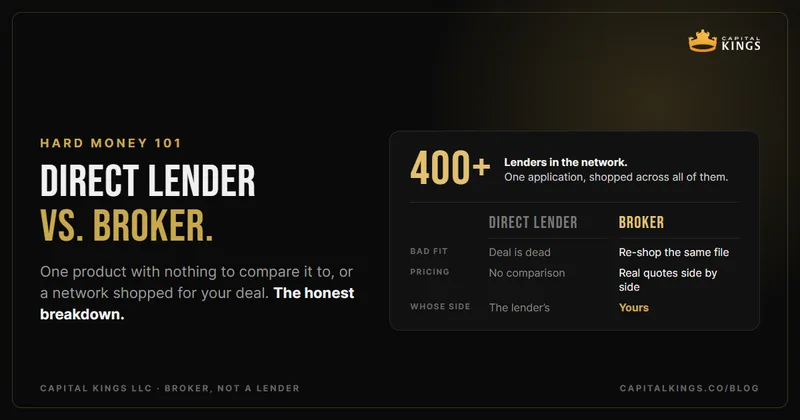
Here's how I work, and it's the opposite of how a lot of brokers operate. I'm not gatekeeping a lender's name from you or hiding fees to force a deal through. Out of the 400-plus lenders I work with, I narrow it down to the top 15 or 20 for your specific deal, reach out to all of them, pull real quotes, take the best 10, and hand you a full side-by-side breakdown of every term. You see everything.
The Number One Mistake First-Timers Make
If I had to name the single most common way new investors hurt themselves, it's over-leveraging by jumping into a second project too soon. It plays out the same way every time. They get into their first fix and flip, the rehab is going well, the excitement kicks in, and before the first one has sold they're already trying to line up a second loan. Now they're paying two contractors, carrying two loans, and their capital is stretched thin across both. One delay on either project and the whole thing wobbles.
The other version of this is leaning too hard on assumed income and not running the numbers correctly on the front end. Slow down. Finish one deal, sell it or refinance it, then scale. The investors who last are the ones who don't get ahead of their own capital.
When I Tell You to Skip Hard Money
I don't put everyone in hard money. If you've got a large down payment, provable income, and a debt-to-income ratio that qualifies you for a conventional loan, take the conventional loan. It's almost always going to carry the most competitive rate, better than hard money and better than DSCR. I'll tell you that straight, even though it's not the deal that pays me.
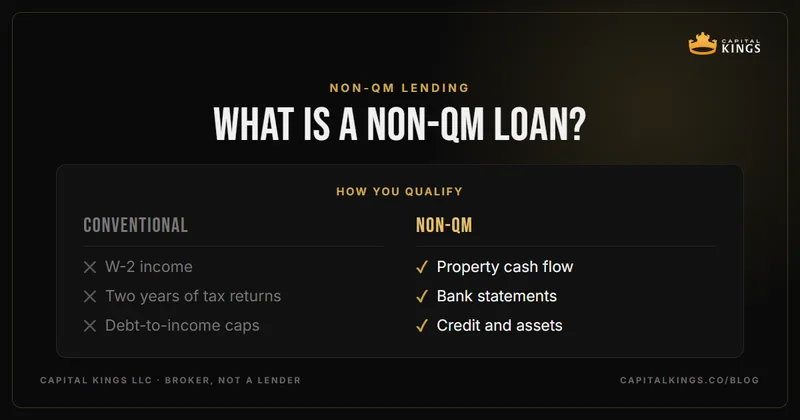
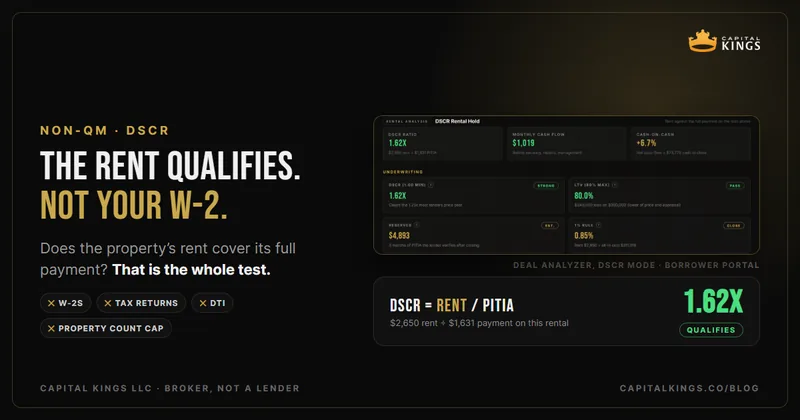
Hard money and non-QM come into play when conventional doesn't fit: your DTI doesn't work, you can't document income the way a bank wants, or you're running a BRRRR strategy where the plan is to refinance into a DSCR loan anyway. That's where these products earn their keep. I break down DSCR against conventional in what a non-QM loan is.
What I'm Quoting Right Now
Rates move with your credit, your experience and how much you put down, so I keep the current numbers on one dated page instead of five: hard money loan rates in Texas. In short, more down gets you a lower rate, less down keeps more cash in your pocket, and the 72-hour close costs the most because it skips the credit check and the in-person inspection. Your deal, your credit, and your timeline move them around, which is exactly why shopping it across a real network matters.
Frequently Asked Questions
Is hard money really more expensive than a traditional loan?
What hard money rates can a first-time investor get in 2026?
Do I pay interest on the rehab budget too?
When should I use a traditional loan instead of hard money?
What is the biggest mistake first-time investors make with hard money?
Want to See Both Options on Your Deal?
Send me your scenario and I'll show you the real numbers side by side: hard money, DSCR, and whether you'd actually be better off conventional. No sales pitch, just the breakdown. You can see both sides priced out today on the fix and flip loan page and the DSCR loan page.
Get Pre-Qualified →