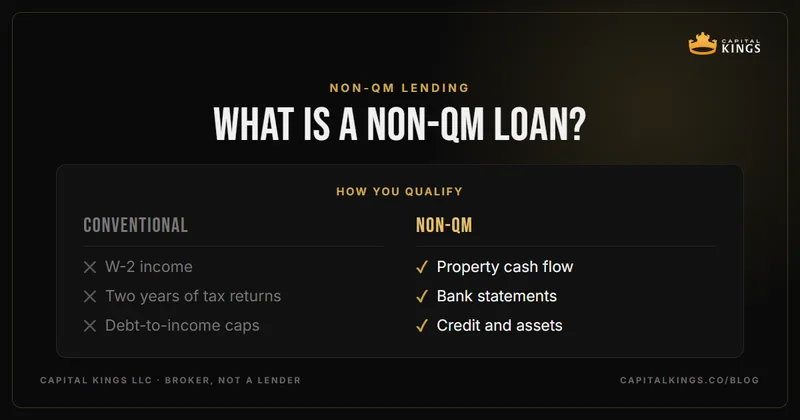
- Non-QM just means the loan doesn't meet the government's Qualified Mortgage rules. That doesn't make it subprime.
- Investors use it because the lender looks at the deal or the property instead of your W-2 and tax returns.
- Non-QM usually costs a bit more than conventional. What you get for that extra cost is flexibility and speed.
If a bank ever told you your income was too complicated, or your tax returns show losses that have nothing to do with what you actually take home, this is the loan built for you. Let me explain it the way I would to a brand new investor sitting across from me.
What Non-QM Means
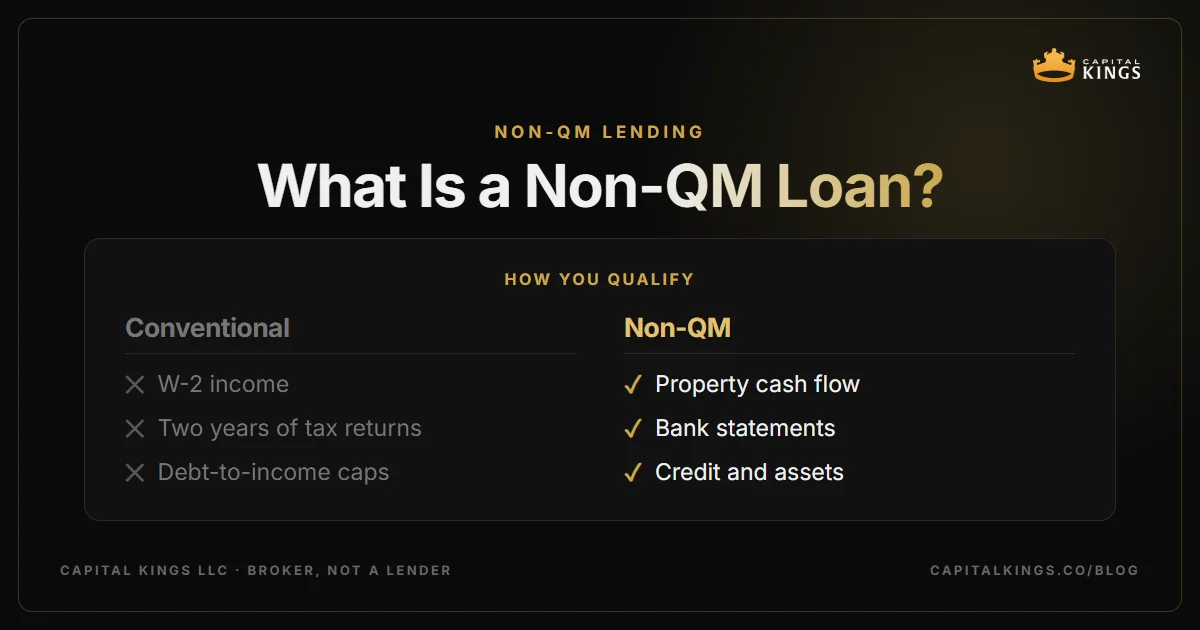
Non-QM just stands for non-qualified mortgage. A conventional mortgage is the one most people know. To get one, you typically need clean tax returns, a solid debt-to-income ratio (your monthly debt payments divided by your gross monthly income), pay stubs, and provable income. Non-QM throws that script out.
Here's the part most people never hear. Non-QM money is privately raised capital. It comes from investors who pool their own funds and lend them out. Because it isn't government-backed, the lender sets its own guidelines instead of following Fannie Mae, Freddie Mac or FHA rules. That doesn't mean there are no rules. A non-QM loan on a home someone lives in is still a consumer mortgage, and the lender still has to verify the borrower can repay it. What changes things for you as a real estate investor is who the loan is for. The non-QM loans you'll actually use are business-purpose loans, made to your LLC or your business on an investment property, not to you personally on a house you live in. That's what keeps them outside the consumer mortgage rules, and it's why they can qualify you on the deal instead of your tax returns.
It Is Not Subprime. That Is the Biggest Myth.
People hear non-QM and assume it means subprime or risky. That's flat wrong. There's a whole prime category inside non-QM. I can have a borrower with an 800-plus credit score and a strong track record, and they'll still close a fix and flip right around nine percent on a hard money loan. That isn't because they're a risky borrower. Hard money is just the right tool for that deal.
Subprime and non-QM aren't the same thing. Non-QM is a giant umbrella. Pretty much anything that isn't conventional, FHA, or government-backed falls under it.
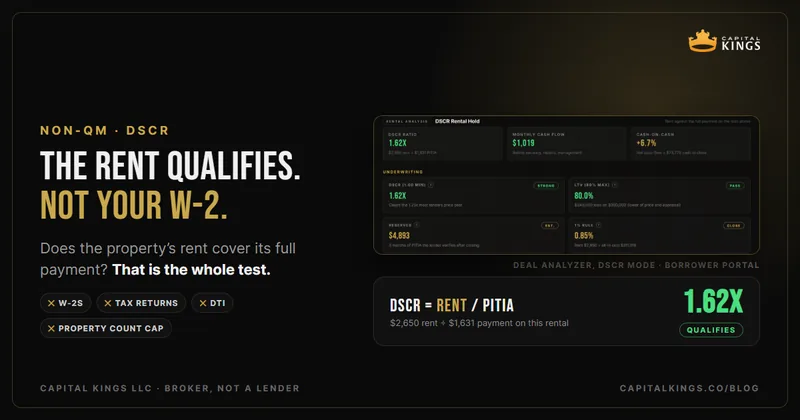
- DSCR loans: the property qualifies on its own rental income, not yours.
- Fix and flip / hard money: short-term, asset-based loans for renovation projects.
- Bridge loans: short-term financing to get from one position to the next.
- New construction: ground-up build financing for investors.
- Bank statement and P&L loans: income documented through deposits instead of tax returns.
Why Investors Reach for Non-QM
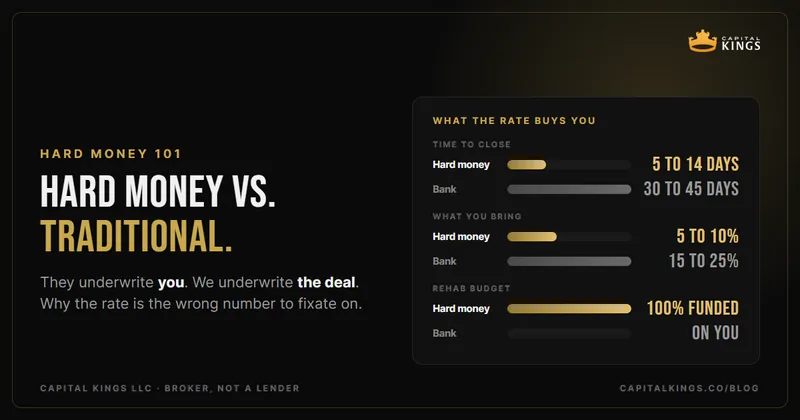
Here's the real reason this loan can change a career. It's the leverage. On a fix and flip, a lot of my lenders will cover ninety percent or more of the purchase price. In the major Texas metros that goes to ninety-five percent even on a first flip; in the other states I broker in, ninety-five percent takes three or more completed flips (five or more in some states). Then they'll fund and reimburse one hundred percent of the rehab budget on top of that. So you can get into a project using mostly somebody else's money.
If you learn how to analyze a deal and run your numbers on the front end, that leverage is how you turn a small amount of your own capital into a real return. It's the single biggest reason a new investor can get off the sidelines and actually start building.
The Real Misconception: Most People Have Never Heard of It
Honestly, the number one thing I run into isn't fear of the rate. It's that most people have never been taught what hard money is. Once a borrower understands it, the process usually goes great, and they're shocked at how fast and easy closing is.
It's not all one flavor, either. Some direct hard money lenders run your credit and only lend to borrowers at 750 or 760 and up with a track record. Plenty of others will fund a brand new investor with zero experience and never pull credit at all. A lot of the time, a borrower finds out all they need is two months of recent bank statements to show proof of funds (showing they have the cash for the deal). That's it, and they can hardly believe it.
DSCR vs. Conventional: When I Send You Each Way
This is where an honest broker earns their keep, because the answer isn't always my product. If a conventional lender will work with you, you can put fifteen to twenty percent down, and the property is in good enough condition to lend on, I'll push you toward conventional. When you qualify for it, conventional is almost always the cheapest money on the board.
DSCR earns its place when conventional can't work. Maybe your income history is inconsistent, your debt-to-income ratio is too high, or you just can't document income the way a conventional lender wants. In any of those cases, a DSCR loan qualifies the deal on the property's rental income instead of yours. Find a strong enough deal and you can often pull cash out on a refinance too. I also have DSCR lenders who work with foreign nationals, and that's a borrower conventional and FHA won't touch.
The Premium You Pay for Flexibility
Non-QM usually costs a little more than conventional. It's often somewhere between half a point and two points higher, depending on the product, the leverage, and your file. On DSCR, a few lenders in my network price the strongest files from about six percent, and my instant term sheet starts a little under seven. Where it starts today, and what moves it, is in the rates guide.
On a six-month fix and flip, that rate gap barely matters, because you're only holding the loan for a few months. On a long-term buy-and-hold, you'll want to weigh it against your monthly cash flow. Either way, the right product depends on your documentation and your strategy. That's exactly why it pays to work with someone who does this every day.
Frequently Asked Questions
What does non-QM mean?
Is a non-QM loan the same as subprime?
Who can get a non-QM loan?
How much higher are non-QM rates than conventional?
When should I use a conventional loan instead of non-QM?
Not Sure Which Loan Fits Your Deal?
That's the exact call I help investors make. Send me your scenario and I'll tell you straight whether it's a conventional play or a non-QM one, before you commit to anything. If it's a rental, start with the DSCR loan page. It has the rates by credit score and a calculator that tells you if the rent covers the payment.
Get Pre-Qualified →