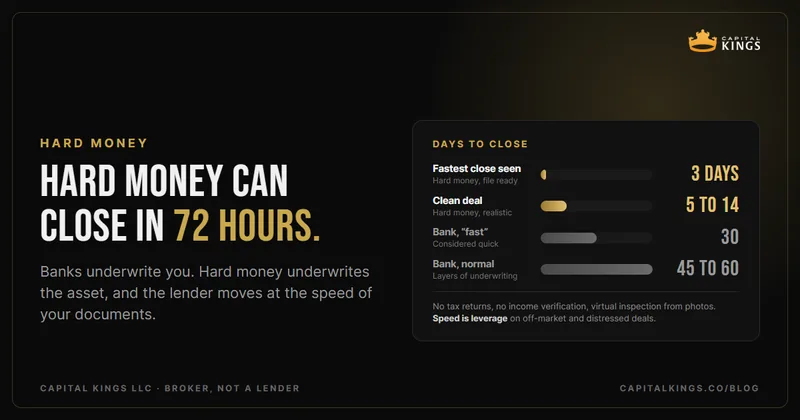
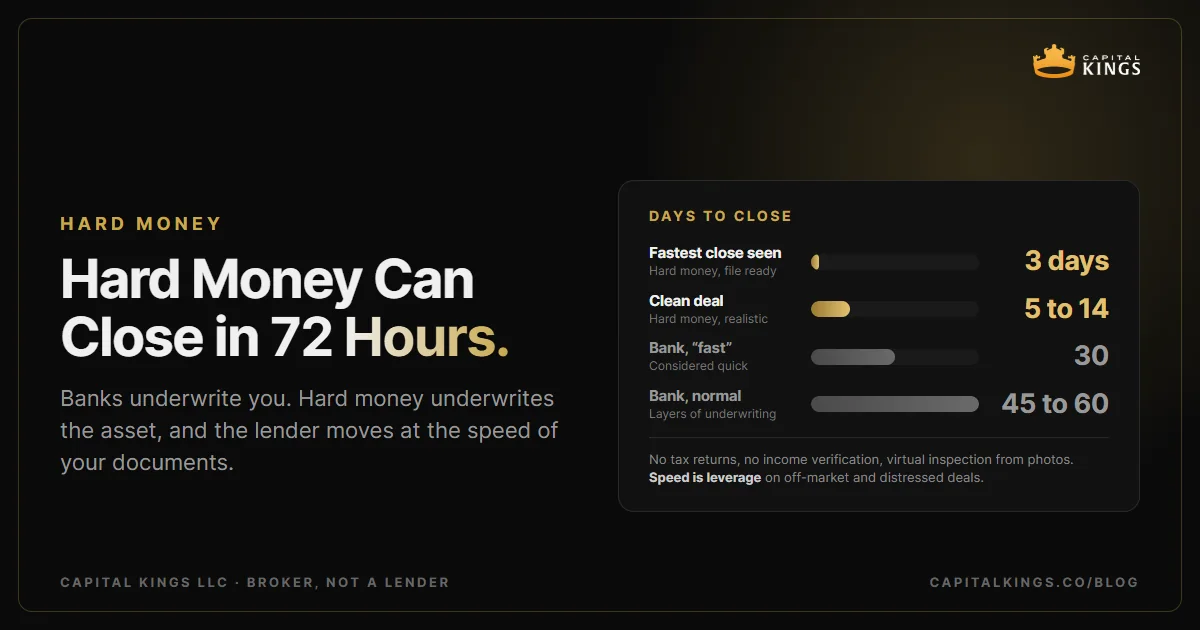
- Banks are slow because they have to verify you and your income. Hard money is fast because the lender is mostly judging the property itself.
- The fastest close I've actually seen is three business days. On a clean deal, five to fourteen days is realistic.
- A fast close gives you real leverage when you make offers. It can win you off-market and distressed deals below asking.
You've heard it a hundred times. Hard money closes in days, and banks take weeks or months. It's true, but most people repeat it without understanding why, and the why matters. Here's the part nobody tells you up front. A fast close depends on you almost as much as it depends on the lender. I'll walk you through what actually makes it fast, what slows it down, and how smart investors use speed to win deals.
Why Banks Are Slow
A bank loan moves through layers. It goes from the loan officer to a processor to an underwriter, and sometimes to a second underwriter to sign off. At every stage, documents get requested, reviewed, sent back for corrections, and reviewed again. The underwriter checks your debt-to-income ratio (how much of your monthly income already goes to debt payments) and verifies your employment. They pull two years of tax returns and document where your down payment came from, including any large deposits that hit your account.
On top of that, a traditional appraisal can take a couple of weeks by itself. Title and insurance have to be confirmed, and disclosures get signed more than once. At a bank, a thirty day close is considered fast, and forty five to sixty days is normal.
Why Hard Money Is Fast
Hard money works the other way around. It's asset-based, which means the lender is really asking one question. Does this property, at this price, justify the loan amount given the risk? You can answer that in hours. Here's what the fastest programs I work with look like:
- A soft credit pull, or none at all on the fastest programs
- No physical inspection, just photos of the property reviewed virtually
- A virtual appraisal you don't even have to pay for before the lender gives its evaluation
- No tax returns, no income verification, no employment checks
- The decision sits with one or two people, not a committee
Take away the hard credit pull, the income review, and the physical appraisal, and the property can be evaluated almost right away. That's where the speed really comes from.
The Fastest I Have Seen: Three Business Days
The fastest close I've actually seen done is three business days, on exactly the program above. The property got evaluated almost on the spot, and the borrower had everything ready to go, which is the half most people skip.
That speed depends on where the house is. The programs that can close in as little as 72 hours lend in Alabama, Arkansas, Colorado, Florida, Georgia, Indiana, Kansas, Missouri, North Carolina, Ohio, South Carolina, Tennessee and Texas. Everywhere else I broker, the faster programs fund in 5-14 days once the file is complete (7-14 in some states), and the First Flip, 10% Down program takes 21-30 days.
The Lender Moves at the Speed of Your Documents
If you remember one thing about a fast close, make it this one, because most loan officers won't say it out loud. The lender can only move your file as fast as you hand over what they ask for. So the things on your side need to be ready before you ever ask for a three day close:
- The rehab budget
- Your LLC or entity documentation
- The signed contract on the property
- Your ID and the rest of the information the lender requests
If those are ready to go, the lender can move fast. If you're scrambling to form your LLC or pin down your rehab numbers after you're already under contract, that's where the days disappear. And that has nothing to do with how fast the lender can actually fund.
What Slows a Fast Close Down
When a quick close drags, it's usually one of a few things, and a lot of them aren't the lender's fault:
- Title problems. A cloud on title (an unresolved problem with the ownership record) or HOA documents you're still waiting on can hold up closing. Sometimes the title company simply can't close on time, and that's completely out of the lender's hands.
- The process getting mishandled. If the borrower and lender aren't talking and the required items don't get ordered in time, the timeline slips.
- Requirements that get missed. Some lenders require an in-person inspection, an in-person appraisal, and a survey. Lining all of that up on a four or five day close is hard, especially when someone's living in the property. I've seen surveys not get ordered until a day or two before closing, and then everyone has to wait on it.
Almost all of it comes back to due diligence on the front end. Get the orders placed early, keep communication tight, and most of these problems never come up.
Speed Is Leverage: How Investors Use It to Win Deals
This is where a fast close stops being a convenience and turns into a real edge. Some of the realtors and investors I work with directly use a quick closing timeline as leverage when they make offers. It works because of who's usually selling these deals.
On a lot of wholesale deals, off-market transactions, and properties that have sat on the MLS for a long time, you're dealing with a distressed seller. They want their money and they want out. When a buyer walks up and says they can close in 5 to 14 days, or in as little as 72 hours in the states where a 72-hour program lends, that's a big incentive, especially in a foreclosure situation or when the seller just needs the cash. I've watched investors lock up properties below what the seller was asking, just because they could close faster than anyone else at the table. Speed is worth real money in a negotiation, so use it.
Frequently Asked Questions
How fast can a hard money loan close?
Why can hard money close so much faster than a bank?
What slows down a hard money closing?
What does a borrower need to close fast?
Can a fast close help you win a deal?
Want to Close Before the Other Buyer Can?
Submit one application and you get an instant term sheet, so you walk into your next offer knowing exactly how fast you can close. That's the kind of speed that wins deals. The programs built for speed, with current rates, are on the fix and flip loan page.
Get Pre-Qualified →