 Broker, not a lender
Hard Money Lenders inChicago, Illinois
Fix and flip, DSCR rental and new construction financing for Chicago investors. We do not lend our own money, we shop your deal across a 400+ lender network and come back with real terms you can compare on total cost.
Prefer to talk it through? Call or text Micah at (281) 636-5682.
What you get working with us
Price a Chicago deal right now
Prefilled with a realistic Chicago deal. Change any number and it reprices instantly on the lanes licensed in Illinois, using the same engine behind our term sheets.
Financing a deal in Chicago
Chicago flips are built on two house types most of the country doesn’t have: the brick bungalow belt that rings the Southwest and Northwest Sides, and the two-flat. Both were built between roughly 1910 and 1940, both are solid masonry with full basements, and both sell to buyers who want space and a yard inside the city limits. Prices here have been climbing again, and a first flip can be priced in Illinois, but the city adds paperwork, taxes and basement water that a Sun Belt investor has never budgeted for.
The Chicago deal is decided at the neighborhood and building-type level. A renovated bungalow in West Lawn, Garfield Ridge or Portage Park sells to an owner-occupant, often a city worker, teacher or a family moving up from an apartment. A two-flat sells on a mix of rent and owner-occupant demand, and the math is different: the buyer is often living in one unit and renting the other. Pick one plan before you write the offer. Deconverting a two-flat to a single-family is expensive and, in some neighborhoods near the 606 and Pilsen, restricted by ordinance, so assume it stays a two-flat unless zoning and the numbers both say otherwise.
What a Chicago deal looks like on paper
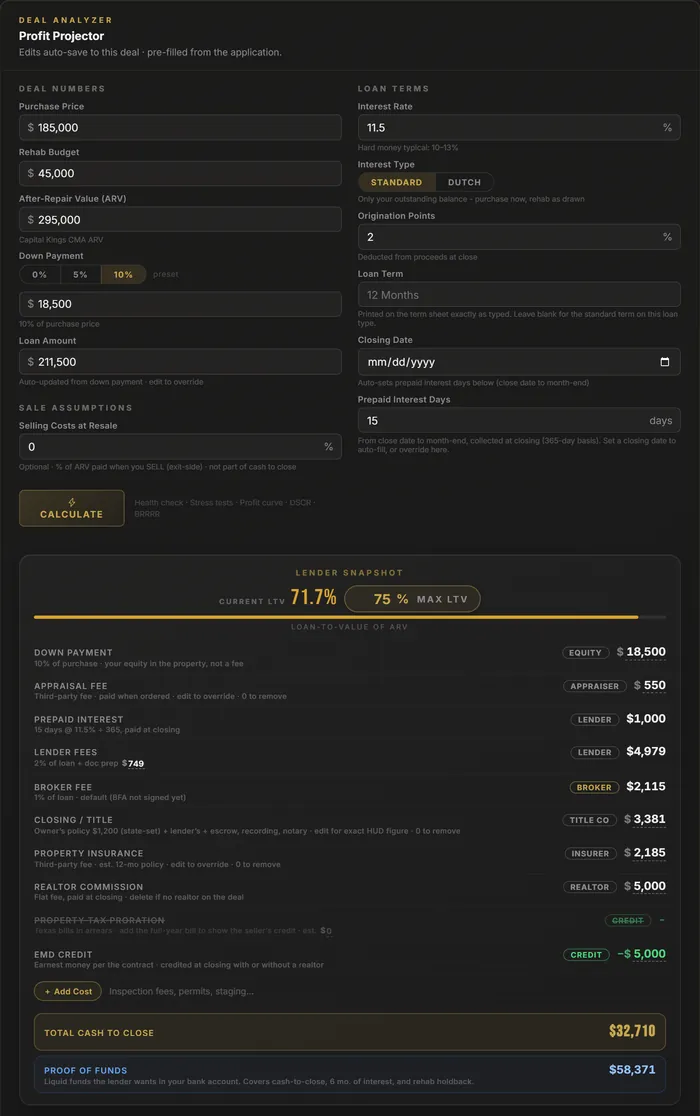
Chicago example: $230,000 purchase, $75,000 rehab, $420,000 after repair value, 730 credit, first flip. The engine puts that borrower on the Best Rate program at 9.49%. Think a 1920s brick bungalow in Chicago Lawn: tuckpointing, a kitchen and two baths, electrical and a flood control valve on the sewer line. Every number below is what the instant term sheet prints for that deal, so the picture cannot contradict the page.
- Down payment (15%)You$34,500
- Origination (0.5%)Lender$2,000
- Doc prepLender$749
- Broker fee (1%)Broker$2,705
- Title and closingTitle$3,672
- Prepaid interest (15 days)Lender$1,055
- Property insuranceInsurer$2,898
- AppraisalAppraiser$550
Interest while you rehab: $1,546 a month on the $195,500 funded at closing, $2,139 once every draw is out. Proof of funds is cash to close plus $18,750 of rehab reserve and $12,835 of interest reserve. Sample borrower, sample address; the sheet is issued by the same engine as the borrower’s instant term sheet.
What we can fund in Chicago
| Program | Down payment | Min credit | Experience | Rate | Origination | Max loan | Term | Close |
|---|---|---|---|---|---|---|---|---|
| Best Rate | 15% | 700+ | First flip OK | 8.99% to 9.49% | 0.5% | 75% of ARV | 12 months | 14 days |
| 5% Down, 3+ Flips1 | 5% | 600+ | 3+ completed flips | 11.00% to 12.00% | 2% | 75% of ARV | 12 months | 7-14 days |
| 5% Down, 5+ Flips2 | 5% | 660+ | 5+ completed flips | 9.99% to 10.99% | 2% | 75% of ARV | 9-24 months | 10-14 days |
- Origination steps down with experience: 1.5% at 5+ deals, 1% at 8+.
- Rate is set per file from 9.99%; origination about 2% plus a $995 processing fee.
Origination has a $2,000 minimum on every program and the broker fee is 1% with a $2,000 minimum. These are the numbers the instant term sheet uses as of September 2026. Strong credit, cash and a track record can price lower through specific lenders in the network.
What the Chicago comps say
Redfin puts the Chicago median sale price at $426,000 for the three months ending August 2026, about 9% above a year earlier, with homes selling in around 49 days; that figure blends condos with houses. Zillow’s home value index for the city is $334,030, up 5.2% over the year. On the Southwest Side, Zillow puts McKinley Park at $344,072, Heart of Chicago at $348,642 and Douglas Park at $293,967.
| Median sale price, Chicago (Redfin, 3 months to Aug 2026) | $426,000 |
| Days on market, Chicago (Redfin) | 49 |
| Zillow home value index, Chicago (Aug 2026) | $334,030 |
| Zillow home value index, McKinley Park | $344,072 |
| Zillow home value index, Heart of Chicago | $348,642 |
| Zillow home value index, Douglas Park | $293,967 |
Sources: Redfin, Chicago housing market · Zillow, Chicago home values · City of Chicago, Full Payment Certificates · City of Chicago, anti-deconversion ordinances
How a Chicago file actually gets priced
Cook County appraisers comp tightly by community area and building type. A bungalow won’t comp against a raised ranch or a frame cottage on the same block, and a two-flat is valued against other two-flats with an eye on rent. We set the ARV on closed sales of the same type inside the same community area over the last 90 days and discount anything that sold with heavy concessions. Illinois property taxes are paid a year in arrears, so the seller credits the buyer at closing, and on a Cook County house that proration is a real number in your cash to close; we show it rather than surprise you with it.
Basement water is the Chicago risk. The city runs on a combined sewer, and in a heavy storm it backs up into basements across the bungalow belt, so an overhead sewer or a flood control valve and a working sump are worth budgeting on almost every house. Much of the pre-1986 housing stock still has lead water service lines that the city is working to replace. Every transfer of real property in Chicago needs a water and sewer Full Payment Certificate from the Department of Finance, the city charges its own transfer tax on top of the state and county, and anything beyond cosmetic work needs a permit through the Department of Buildings. Tuckpointing, parapets and chimneys are the masonry line items to price.
Who buys your finished Chicago deal
The finished Chicago bungalow goes to an owner-occupant on an FHA or conventional loan, and in the Southwest Side community areas that buyer is price sensitive and comparing your house to other bungalows two blocks away, not to new construction. Finish to the block: clean masonry, a dry basement, an updated kitchen and a second full bath carry the most weight. Two-flats exit to house hackers and small landlords, and they can also be refinanced on a DSCR loan when the rents cover it, which makes them a flexible exit. Redfin has Chicago homes selling in around seven weeks, so plan the carry with some runway.
Your whole loan, in one portal
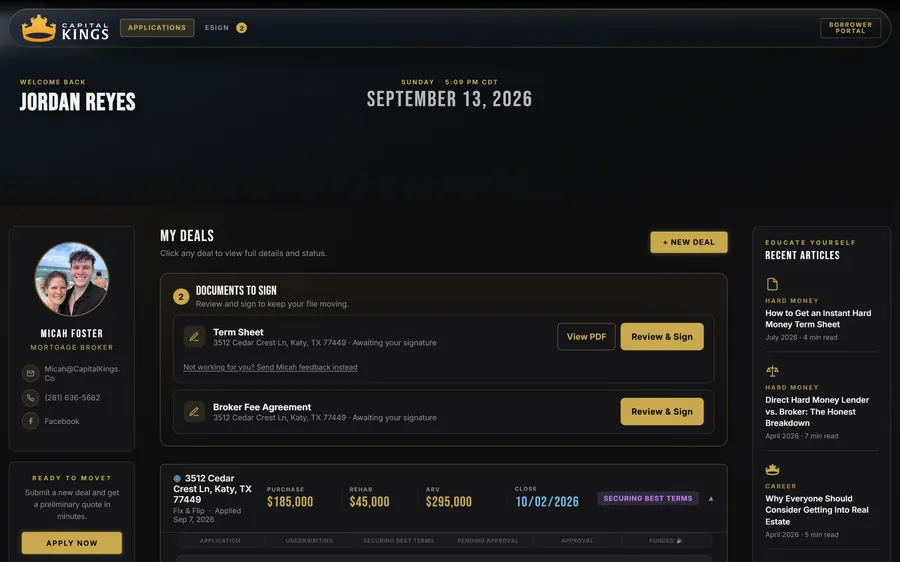
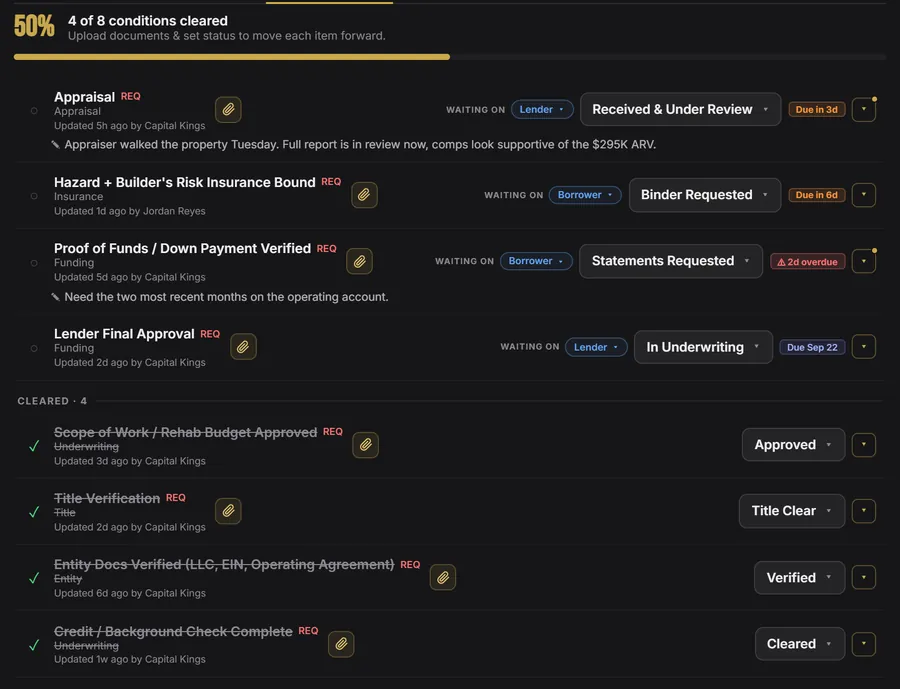
Apply once and the whole Chicago loan lives in the borrower portal: the term sheet you can accept and sign in the browser, where the loan stands, one place for documents, and the list of what the lender is still waiting on. These are real screens from the portal.

What we fund in Chicago
Fix & Flip
Purchase plus 100% of rehab, released in draws. The core product in Chicago.
DSCR Rental
Qualifies on the property’s rent, not your W-2. The usual exit when a flip becomes a hold, and the long-term financing on a BRRRR.
New Construction
Ground-up for builders and infill developers, with a draw schedule matched to the build timeline.
Where we lend in Chicago
We broker deals across the whole Chicago market. These are the submarkets investors ask us about most:
From deal to funded
Send the deal
Address, purchase price, rehab budget and your ARV. Three minutes, no credit pull.
We shop it
Your scenario goes to the lenders in our network that actually fit it and are licensed in Illinois, not all 400 at once.
Real terms back
Rate, origination, leverage and cash to close side by side, so you can compare on total cost.
Close
7 to 10 days typical. We stay on title and the lender through funding.
Chicago hard money FAQ
Do you lend hard money in Chicago?
Which fix and flip programs apply in Chicago?
How fast can a Chicago hard money loan close?
How much do I need to bring to close on a Chicago flip?
Do you fund the rehab budget in Chicago?
What credit score do I need for a Chicago fix and flip loan?
Can I refinance a Chicago flip into a rental loan?
Can I get a hard money loan on a Chicago two-flat?
What Chicago closing costs should a flipper plan for?

Before you sign anything
Ready to fund your Chicago deal?
Submit your scenario in under 3 minutes. We shop it and come back with real terms, not a generic rate sheet.